The Ticket Window to Space Is Open — If Your Wallet Is Deep Enough
Five years ago, "space tourist" still sounded like science fiction. Today it's a line item in travel budgets — admittedly, very large travel budgets. The cost of space tourism in 2026 ranges from roughly $750,000 for a few minutes of weightlessness to $55 million or more for a multi-day stay in orbit, and the industry is in the middle of its most interesting shake-up yet.
Here's the strange part: in 2026, demand isn't the problem. Supply is. One major suborbital provider has paused flights entirely, another is betting everything on a new spacecraft, and orbital seats remain so scarce that entire nations are buying them one at a time. Let's break down what it actually costs to leave Earth this year, what you get for the money, and when those numbers might finally come down.
How Much Does Space Tourism Cost in 2026? The Short Answer
Before we dig into each provider, here's the landscape at a glance:
| Experience | Provider | Price (2026) | Duration | Altitude | Status |
|---|---|---|---|---|---|
| Suborbital rocket flight | Blue Origin (New Shepard) | ~$200K–$450K (estimated) | ~11 minutes | ~105 km | Paused as of Jan 2026 |
| Suborbital spaceplane | Virgin Galactic (Delta class) | $750,000 | ~90 minutes (few min weightless) | ~85–90 km | Sales open; flights expected late 2026–2027 |
| Free-flying orbital mission | SpaceX (Crew Dragon) | ~$50M–$55M per seat (estimated) | 3–6 days | 300–1,400 km | Flying now, by charter |
| ISS visit | Axiom Space (via SpaceX) | ~$55M per seat (estimated) | ~2 weeks | ~400 km | Next mission targeted for early 2027 |
Three things jump out. First, the gap between suborbital and orbital pricing isn't a gap — it's a canyon, roughly 70 times the price. Second, none of these prices have fallen meaningfully since 2021. Third, the cheapest option on the board isn't currently flying. Let's take them one at a time.
Blue Origin's New Shepard: The Pause Heard Round the Industry
Blue Origin's New Shepard was, until recently, the most active tourist ride in the business — a fully autonomous rocket that lofts six passengers past the Kármán line (the internationally recognized 100-kilometer boundary of space) for about three minutes of weightlessness and a panoramic view of Earth through the largest windows ever flown.
The company never published a price list. The first seat famously sold at auction for $28 million back in 2021, but industry estimates have long pegged typical seats at $200,000 to $450,000, with some charter arrangements reportedly running over $1 million.
Then came the plot twist. In late January 2026, Blue Origin announced it would pause New Shepard flights for at least two years, redirecting resources toward its Blue Moon lunar landers in support of NASA's Artemis program. For the company, the moon is simply a bigger prize than suborbital joyrides. For would-be passengers, it means the entry-level tier of space tourism just lost its most reliable operator.
What the experience was like: Two days of training at Blue Origin's West Texas site, covering safety procedures and how to move in microgravity. The flight itself lasts about 11 minutes from liftoff to parachute landing — short, intense, and by all passenger accounts, transformative.
Virgin Galactic: A $750,000 Bet on the Delta Class
Virgin Galactic is the only company currently selling suborbital tickets to the general public, and in April 2026 it reopened sales at $750,000 per seat — up from $600,000 in the 2023–2025 window, and a long way from the $200,000 tickets early believers bought two decades ago. A reservation requires a $1,000 deposit.
The price hike comes with a genuinely new vehicle. After retiring its workhorse spaceplane VSS Unity in 2024, the company went all-in on its next-generation Delta class — designed to fly weekly rather than monthly, with six passenger seats instead of four. According to SpaceNews, the first Delta ship began ground testing this spring, with test flights expected in the third quarter of 2026 and commercial research flights in the fourth quarter. Private passenger flights would follow six to eight weeks later — which means paying customers may realistically fly in early 2027.
What you get for $750,000: Several days of training at Spaceport America in New Mexico, then a roughly 90-minute flight. A carrier aircraft hauls the spaceplane to about 45,000 feet, releases it, and the rocket motor ignites for a steep climb past 85 kilometers. You'll get a few minutes of weightlessness, the curvature of the Earth against the black of space, and a runway landing rather than a parachute splashdown.
One sobering stat: roughly 650 "Future Astronauts" already hold tickets from earlier sales rounds. Even flying weekly with six seats, working through that backlog will take Virgin Galactic the better part of two years before new buyers strap in.
SpaceX and Axiom: Orbital Travel Is a Different Sport Entirely
If suborbital flight is a taste of space, orbit is the full meal — and it's priced accordingly. There are two ways to buy it in 2026.
The free-flyer mission. SpaceX's Crew Dragon can be chartered for multi-day missions that never dock with anything, and the recent track record is remarkable. The Polaris Dawn mission in September 2024 carried four private astronauts to 1,400 kilometers — farther from Earth than any humans since Apollo — and included the first commercial spacewalk. Then in March 2025, the Fram2 mission flew four spaceflight rookies into a polar orbit no crewed spacecraft had ever attempted. SpaceX doesn't publish prices, but full missions are estimated at $200 million or more, with per-seat figures generally cited around $50–55 million.
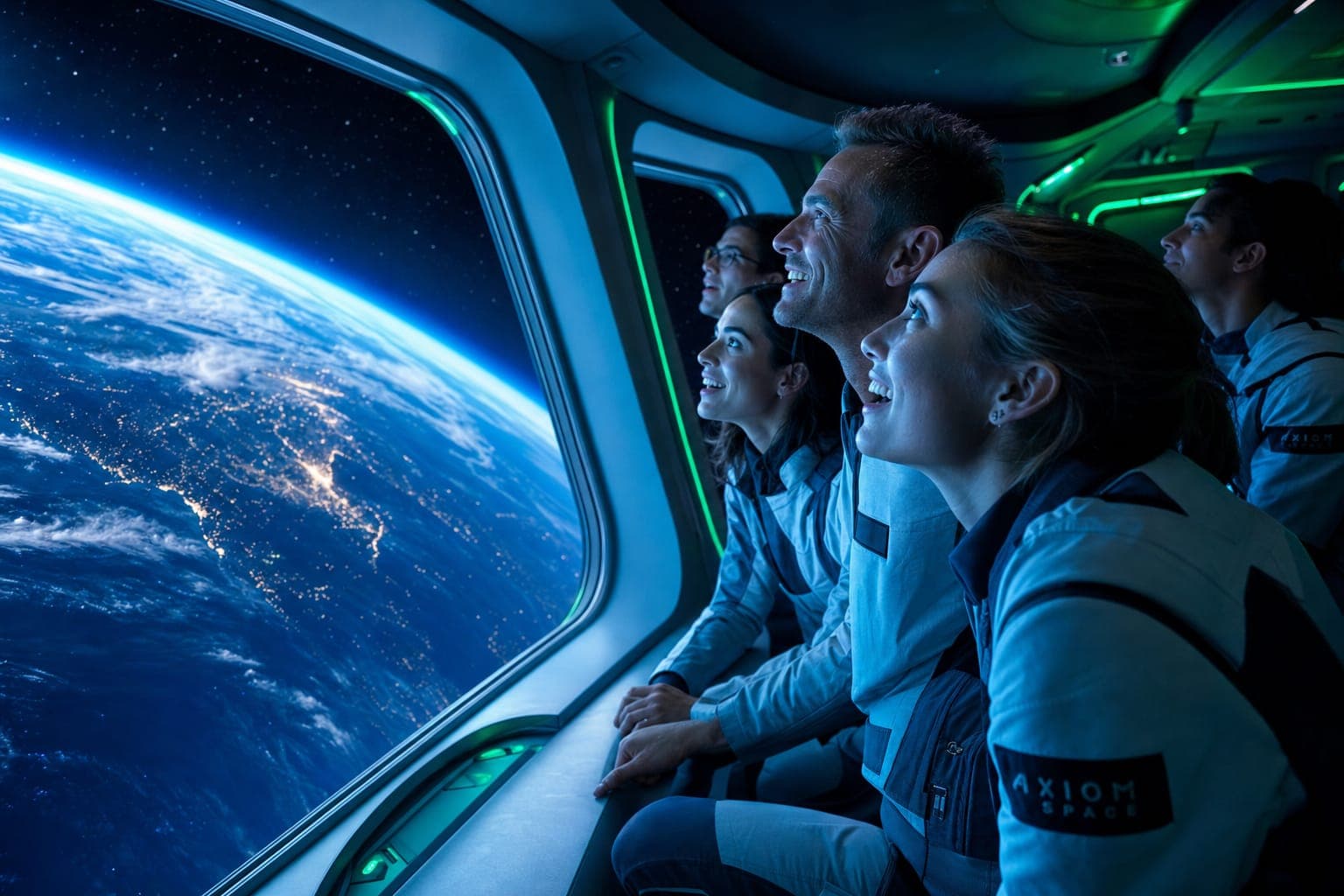
The space station visit. Houston-based Axiom Space brokers roughly two-week trips to the International Space Station aboard Crew Dragon, at an estimated $55 million per seat. The interesting shift: Axiom's customers are no longer thrill-seeking billionaires. The Ax-4 mission in mid-2025 carried government-sponsored astronauts from India, Poland, and Hungary — each nation's first spacefarer in over 40 years. National prestige, it turns out, is a more durable market than personal bucket lists. NASA has approved Axiom's fifth mission for no earlier than January 2027.
Orbital travel also demands real commitment beyond money. Axiom crews train for months at NASA's Johnson Space Center, learning station systems, emergency procedures, and the science experiments that increasingly justify these flights. Crews on recent missions have worn continuous biometric monitors and run dozens of human-research studies — the same class of sensors we covered in Wearable Technologies for Post-Surgical Monitoring and Care, now gathering data on how the human body handles microgravity.
Why Hasn't the Price Dropped Yet?
The frustrating truth: space tourism prices in 2026 are flat or rising, not falling. Virgin Galactic raised prices 25 percent this spring. Blue Origin stepped away from the market. Orbital seats cost about what they did in 2021.
The reasons are structural, not greedy:
- Tiny supply. Total tourist capacity across the entire industry is measured in dozens of seats per year, against waitlists in the hundreds. When demand outstrips supply that badly, prices climb.
- Hardware economics. Suborbital vehicles are reusable, but turnaround, inspection, and crew costs remain high at low flight rates. The cost curve only bends with volume — which is exactly what Virgin's Delta class is designed to deliver.
- Opportunity cost. Blue Origin's pause is the clearest signal: for companies with bigger ambitions, NASA lunar contracts and satellite launch revenue dwarf what tourism brings in. Tourism gets a company's spare capacity, not its best capacity.
There's a useful parallel in the early airline era. In 1939, a transatlantic ticket on the Pan Am Clipper cost the equivalent of more than $9,000 today, and flying was a stunt for the wealthy. Three decades of volume, competition, and better aircraft made it ordinary. Space is earlier on that same curve than the marketing suggests — but it is on the curve.
When Will Space Tourism Get Cheaper? Three Scenarios for the 2030s
Forecasting this industry is humbling — nearly every past prediction has been too optimistic on timing. So rather than one forecast, here are three grounded scenarios for where prices could sit by the early-to-mid 2030s.
The conservative case: prices plateau. Delta-class flights ramp slowly, Blue Origin's pause stretches past two years, and orbital capacity stays tied to Crew Dragon. Suborbital holds at $500,000–$800,000; orbital stays north of $40 million. Space tourism remains a product for the ultra-wealthy and for governments.
The base case: suborbital gets "merely expensive." Virgin Galactic reaches weekly flights by 2028 and adds ships; Blue Origin returns with upgraded hardware around the same time; competition resumes. Suborbital drifts down toward $200,000–$300,000 — first-class-around-the-world money, not house money. Orbital eases to $25–35 million as commercial stations like Axiom's begin replacing ISS access.
The breakout case: Starship changes the math. SpaceX's fully reusable Starship is the wildcard. It's designed to carry dozens of people at a marginal cost closer to a long-haul flight than a space mission. If crewed Starship flights become routine in the early 2030s — a real "if," given its test program — orbital trips at $1–5 million become thinkable, and the entire suborbital market gets squeezed from above. Most analysts treat this as a 2030s possibility, not a promise.
Our honest read: the base case is most likely, with the breakout case as a genuine tail possibility. Falling launch costs are the most reliable trend in spaceflight — the same force making satellite constellations viable, as we explored in The Future of Mobile Connectivity: Exploring 5G and Beyond Technologies — and tourism prices ultimately follow launch costs with a lag.
What This Means If You're Watching From the Ground
For nearly all of us, 2026 is a spectator year — but a meaningful one. The industry is professionalizing: vehicles built for weekly operations, training programs with real curricula, national space agencies buying seats like airline tickets. That's what an industry looks like just before it scales, and the AI-driven automation transforming everything from flight software to mission planning — a shift we've tracked in AI & Machine Learning: The Future is Here! — is quietly lowering operating costs behind the scenes.
If you're serious about going someday, the practical advice is simple. Don't buy at the top of a supply-constrained market unless flying soon matters more to you than money. Watch two signals: Virgin Galactic's Delta-class flight cadence through 2027, and the first crewed Starship milestones. When either provider starts advertising availability instead of waitlists, the price curve is about to bend.
The key takeaway: going to space in 2026 costs between $750,000 and $55 million depending on how high and how long — but the more important number is the flight rate. Prices won't fall because companies get generous; they'll fall when vehicles fly weekly instead of quarterly. That shift has finally, visibly begun. The first generation of space tourists paid for the view. The next one will pay for the engineering they funded.