The Decade of "Two Years Away" Is Over
For roughly ten years, fully self-driving cars were perpetually two years away. Executives promised, deadlines slipped, and the joke wrote itself. But something genuinely changed over the past eighteen months: robotaxis stopped being a demo and started being a commute. In Phoenix, San Francisco, Los Angeles, Austin, and Atlanta, ordering a car with no one in the driver's seat is now about as remarkable as ordering a burrito.
The numbers tell the story. Waymo closed out 2025 operating roughly 2,500 driverless vehicles and delivering hundreds of thousands of paid rides every week — a scale that would have sounded like science fiction in 2020, as the company detailed in its year-in-review. Tesla launched its long-promised robotaxi service. Amazon's Zoox put toaster-shaped pods on the Las Vegas Strip. So the question for 2026 isn't whether robotaxis work. It's whether they're ready — technically, economically, and socially — to matter to most people. Let's take an honest inventory.
Waymo: The Robotaxi Frontrunner by a Wide Margin
Any serious assessment starts with Waymo, because Alphabet's self-driving unit is operating at a scale no competitor approaches. Its service now covers major swaths of metro Phoenix, the San Francisco Bay Area, Los Angeles, Austin, and Atlanta — the latter two through a partnership that puts Waymo vehicles directly in the Uber app. In late 2025 the company also began offering freeway driving for riders in several markets, removing one of the last big asterisks on its service maps.
The expansion pipeline is just as telling. Waymo has announced plans and begun groundwork in cities including Miami, Dallas, Houston, San Antonio, Denver, Nashville, and Washington, D.C., and has started testing in Tokyo and announced intentions for London. This is no longer a pilot program; it's a rollout playbook being executed city by city.
Why the confidence? Data. Across more than 100 million fully driverless miles, Waymo's published safety research shows dramatically fewer crashes than comparable human drivers — including roughly 80% fewer injury-causing crashes and an even steeper reduction in serious-injury and pedestrian-injury events. Independent researchers and insurers have broadly corroborated the direction of these findings, even while debating the exact magnitudes. No technology is flawless, and Waymo has faced federal scrutiny over specific behaviors, including how its vehicles handle stopped school buses. But the aggregate evidence increasingly supports a claim that once sounded like marketing: these cars crash less than we do.
Tesla's Robotaxi: Real Progress, Smaller Than the Hype
Tesla finally entered the arena in June 2025, launching a robotaxi service in Austin with Model Y vehicles — initially with a Tesla employee riding along as a safety monitor in every car. In December 2025, the company began testing in Austin with no human monitor on board, a genuine milestone for its camera-only, end-to-end AI approach, though the vehicles still operate under remote human supervision.
Context matters, though. As of early 2026, Tesla's Austin fleet numbers in the dozens of vehicles — versus Waymo's thousands — and its Bay Area service still uses safety drivers behind the wheel. The Austin service area has grown impressively, expanding to roughly twelve times its original footprint, but the gap between Tesla's promises (a million robotaxis, remember) and its deployment remains wide.
Still, dismissing Tesla would be a mistake. Its bet is fundamentally different from Waymo's: if self-driving can be solved with cameras and neural networks alone, without expensive lidar and high-definition maps, then every Tesla rolling off the line is potentially a robotaxi, and the purpose-built Cybercab — slated for volume production in 2026 — could rewrite the economics of the entire industry. That's a big "if," and the company now has to prove it with safety data rather than keynote slides. 2026 is the year we find out whether the camera-only approach scales.
Zoox, Cruise, and the Rest of the Field
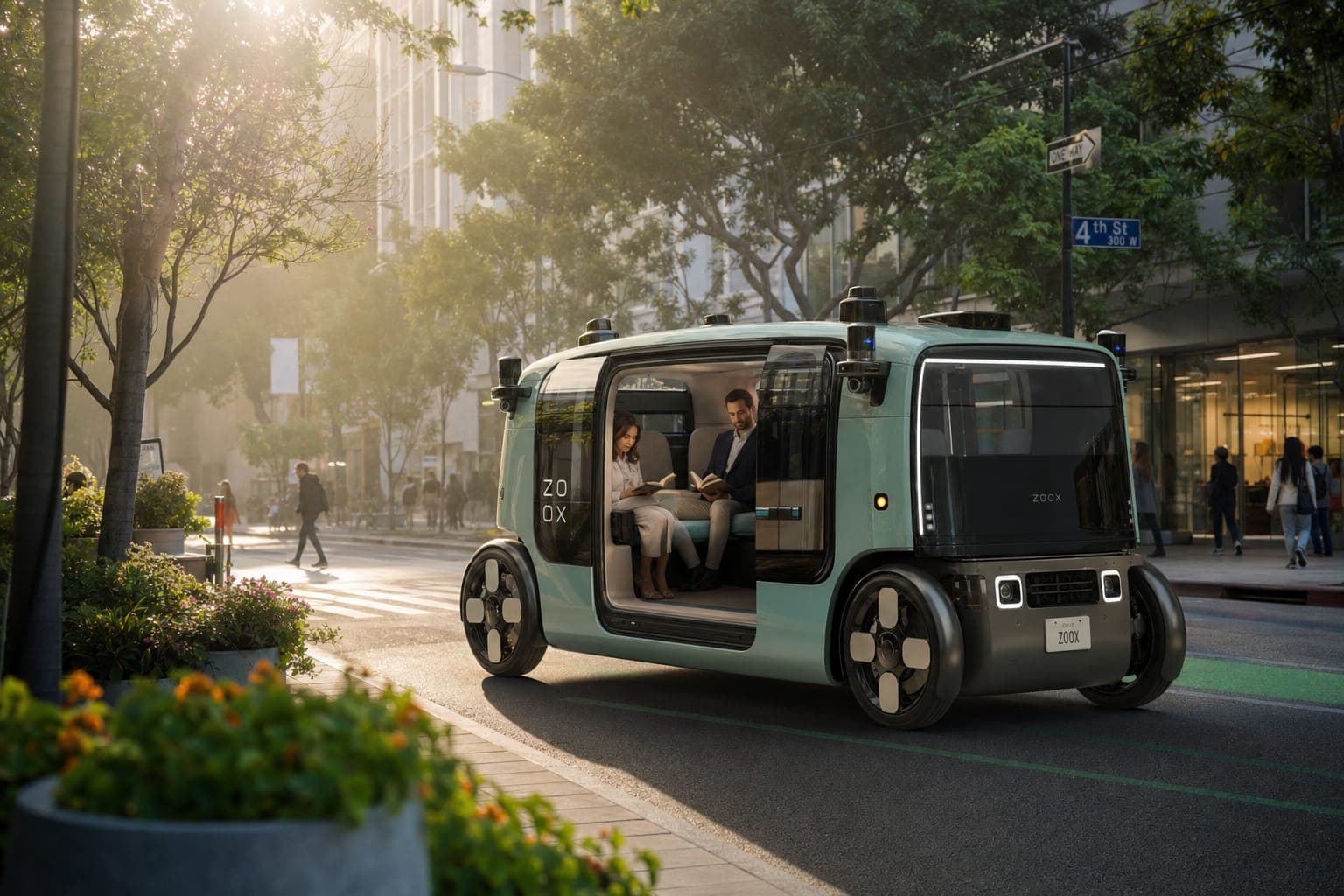
Amazon's Zoox took the boldest design path: a purpose-built pod with no steering wheel, no pedals, and carriage-style seating for four. After years of testing, Zoox launched its first public service in Las Vegas in September 2025, offering free rides between marquee destinations like Resorts World and AREA15, with San Francisco next on its list. It's small, deliberate, and backed by a company with very deep pockets and very strong opinions about logistics.
The field also has a cautionary tale. GM's Cruise — once Waymo's closest rival, running paid driverless rides in San Francisco — collapsed after a 2023 incident in which one of its cars dragged a pedestrian who had been knocked into its path by a human driver. The botched aftermath cost Cruise its California permits, its credibility, and ultimately its existence: GM pulled funding in December 2024 and folded the technology into its driver-assistance programs. The lesson the whole industry absorbed is that trust is the real product, and it can be destroyed in a single news cycle.
Beyond the U.S., the race is global. Baidu's Apollo Go runs large fleets in Chinese cities, while WeRide and Pony.ai have pushed into the Middle East. Robotaxis are not an American experiment; they're an international competition with real geopolitical stakes.
Where You Can Actually Ride One Today
As of January 2026, here's the practical map for a U.S. rider:
- Phoenix: Waymo's oldest and largest territory, including airport connections
- San Francisco Bay Area: Waymo across the city and into the Peninsula, with freeway routes
- Los Angeles: Waymo across a broad and growing service area
- Austin: the only two-robotaxi town — Waymo via the Uber app, Tesla via its own
- Atlanta: Waymo through Uber
- Las Vegas: Zoox's pods on and around the Strip
The honest caveat: coverage is metro-specific and incomplete. Robotaxis still mostly avoid snow and severe weather, which is why the early map is sunbelt-shaped. Airport access, suburb-to-suburb trips, and bad-weather reliability remain works in progress — and if you live outside these metros, the revolution is still a spectator sport for now.
As for the experience itself: pricing generally lands in the same range as Uber or Lyft, sometimes a bit higher at peak times, and the rides are almost aggressively uneventful. The car arrives, unlocks via the app, plays your music if you like, and drives with the patience of the world's most cautious chauffeur. First-timers report the novelty wears off in about ten minutes — which, for a technology whose entire job is to be boring, is the highest possible compliment. The empty driver's seat goes from unnerving to unremarkable faster than almost anyone expects.
The Hurdles Robotaxis Still Have to Clear
Technical capability was the first mountain. Several more stand behind it.
Economics. A Waymo vehicle carries a six-figure sensor-laden price tag, plus depots, remote-assistance staff, cleaning, and insurance. Waymo's per-ride economics are improving with scale, but nobody in the industry is printing money yet — Alphabet has poured well over ten billion dollars into the effort across its lifetime, and analysts still debate when, or whether, individual markets turn profitable. The path runs through cheaper vehicles, higher utilization, and denser service areas — which is exactly why Tesla's low-cost bet and Zoox's purpose-built design matter so much to the whole industry's math.
Regulation. The U.S. still lacks a comprehensive federal framework, leaving a patchwork of state rules. Federal regulators have shown they will investigate aggressively — Waymo, Tesla, and Zoox have all faced NHTSA probes — and a single high-profile failure can freeze deployment, as Cruise proved.
Public trust and labor. Surveys consistently show a majority of Americans remain wary of riding in driverless cars, even as actual riders report high satisfaction. Meanwhile, ride-hail driving is income for millions of people, and the displacement question is no longer hypothetical in robotaxi cities — a tension we explored in The AI Co-Worker: How Automation Is Changing the Workplace.
Cities themselves. Curb space, emergency-vehicle interactions, and traffic flow all change when thousands of driverless cars join the grid. How urban infrastructure adapts to autonomous machines is a bigger story than any one company, one we dug into in Robots at Home and in the City.
Three Scenarios for the Next Five Years
Anyone who tells you they know exactly how this plays out is selling something. Here are three plausible futures, in rough order of likelihood.
Scenario 1: The steady conquest (most likely). Waymo's playbook keeps working: a few new metros per year, gradually thickening coverage, weekly rides climbing toward the millions. Tesla scales to a handful of cities with mixed results, Zoox carves out dense urban niches, and by 2031 robotaxis are a normal option in 30 to 40 U.S. metros — meaningful, but still a minority of total rides. Car ownership dips slightly in covered cities; everywhere else, life looks the same.
Scenario 2: The cost breakthrough. Tesla's camera-only approach proves safe at scale, or sensor costs collapse industry-wide, and per-mile prices fall below private car ownership for urban households. Adoption goes nonlinear: fleets multiply, parking demand craters in city cores, and autonomy becomes the default for urban trips by the early 2030s. This is the future the optimists are pricing in — possible, but it requires several hard things to go right simultaneously.
Scenario 3: The stall. A severe, well-publicized failure — or a string of smaller ones — triggers a regulatory clampdown in a major state, insurance costs spike, and expansion freezes for years. Cruise showed this isn't a hypothetical. The technology would survive, but the timeline would stretch by half a decade, and consolidation would leave only the deepest-pocketed players standing.
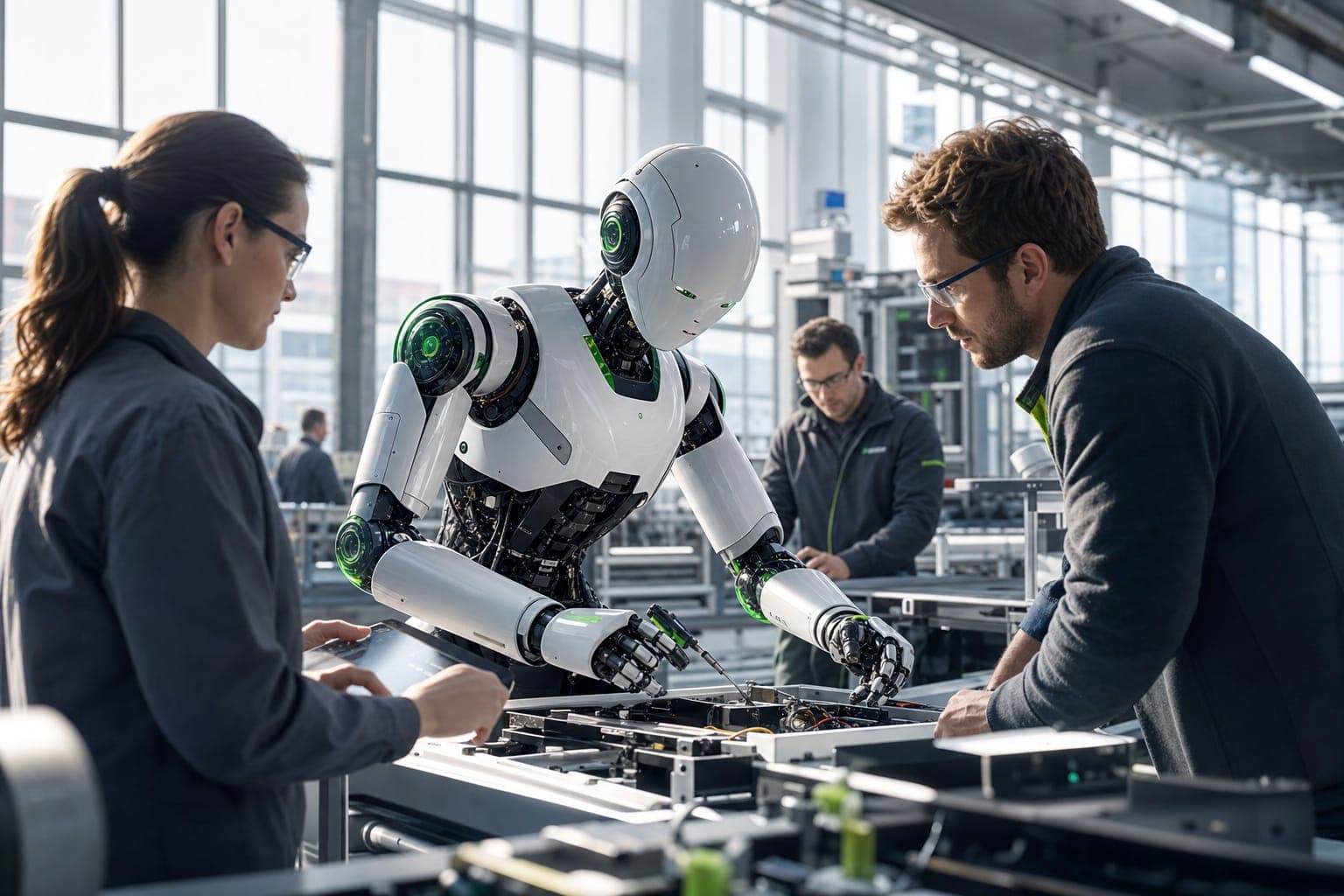
The wild card across all three is the broader wave of physical-world AI. The same advances driving autonomous vehicles — perception, planning, machines that act rather than merely answer — are reshaping software agents too, as we covered in What is Agentic AI? The Technology That Will Replace Your To-Do List — and putting humanoid robots onto factory floors, physical AI's other frontier. Progress in one domain keeps compounding in the others.
The Bottom Line
So, are robotaxis finally ready? In the cities where they operate: yes, genuinely — millions of people now treat a driverless ride as ordinary, and the safety data so far suggests the machines are measurably better than the average human at not hitting things. As a transformation of how most people get around: not yet. Coverage is thin, economics are unproven, and trust must be earned one uneventful ride at a time.
The key takeaway is that the question has changed. For a decade we asked whether autonomous vehicles would ever work. Now we're asking how fast they'll spread, who will profit, and how our cities will adapt — which is exactly what "ready" looks like at the beginning. The decade of "two years away" is over. The decade of rollout has begun.