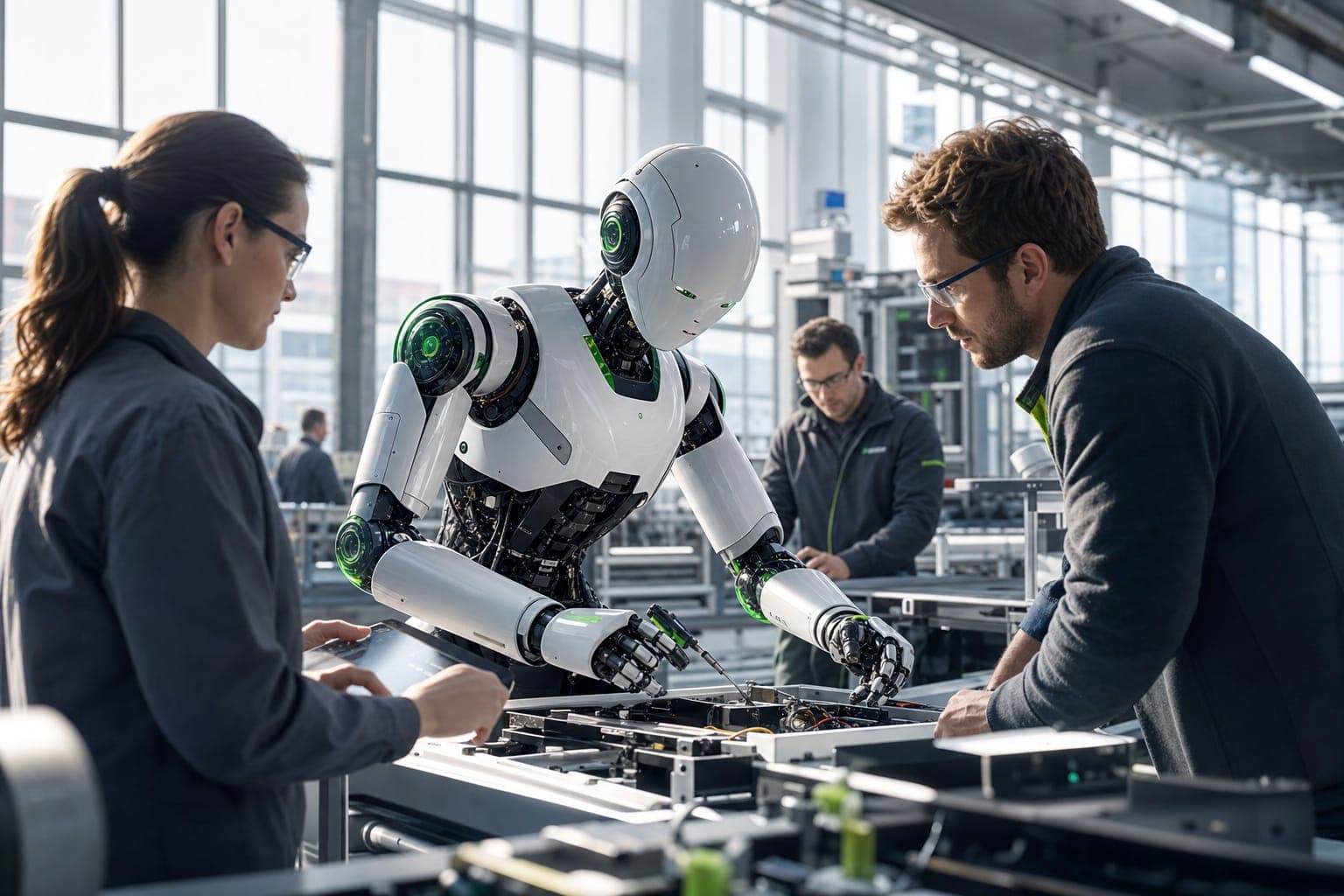
The Quarter the Robots Clocked In
On January 21, 2026, Tesla started mass production of its Gen 3 Optimus robot at its Fremont factory — and a week later, Elon Musk declared the company was beginning "the fastest production ramp of any large complex manufactured product ever," anchored by a planned one-million-unit production line. Whatever discount you apply to Musk timelines (and history says you should apply a generous one), something real shifted this quarter: humanoid robots stopped being demo-day curiosities and started becoming line items in capital budgets.
Tesla is not alone, and that's the bigger story. Hyundai says it will deploy more than 25,000 Boston Dynamics Atlas robots across its factories. Figure's humanoids spent a year doing actual work inside a BMW plant. China's Unitree shipped thousands of units last year at price points that would have sounded like typos in 2023. The future of labor is no longer a thought experiment — it's a pilot program with a purchase order. So let's take stock of where humanoid robots actually stand in early 2026, separate the shipping products from the showmanship, and think honestly about what happens to work.
Why Humanoid Robots, and Why Now
Industrial robots are nothing new — car factories have used robotic arms for half a century. But those machines are bolted down, fenced off, and programmed for one repetitive task. The humanoid pitch is different: a general-purpose worker shaped like us, because the entire built world — doorways, stairs, shelves, tools, vehicles — was designed for the human form. One machine, retrainable across thousands of tasks, that slots into existing workplaces without retrofitting them.
For decades that pitch failed on two fronts: the hardware couldn't balance and manipulate reliably, and the software couldn't generalize. Both walls cracked at once in the mid-2020s. The same transformer-based AI behind chatbots turned out to be a breakthrough for robotics — instead of hand-coding every motion, companies now train "vision-language-action" models on enormous libraries of demonstration video, letting robots learn tasks by watching rather than by being programmed. Meanwhile, the electric-vehicle supply chain drove down the cost of the actuators, batteries, and sensors that make up a robot's body.
Add a genuine economic pull — manufacturing and logistics operators across the US, Europe, China, Japan, and South Korea all report chronic difficulty filling physically demanding roles — and you get the current moment: technology that finally sort of works, meeting industries desperate enough to pilot it. Goldman Sachs has projected the humanoid robot market could reach 38 billion dollars by 2035, a forecast the bank has already revised upward once as costs fell faster than expected.
Tesla Optimus: The Million-Robot Bet
Tesla's program is the loudest, the most ambitious, and the hardest to evaluate — all at once. The facts as of mid-February 2026: Gen 3 production has begun at Fremont, Musk says more than 1,000 Optimus robots are already operating on the production floor there, and the company line is that Optimus will eventually matter more than the entire car business. The Gen 3 design centers on new hands with 22 degrees of freedom — a recognition that dexterous manipulation, not walking, is the real frontier. Robots that can't handle a cable, a bin, or a torque wrench are just expensive mannequins.
The skeptic's notes are equally factual. Most of those floor robots are reportedly there for learning and data collection rather than productive work. The Gen 3 reveal slipped repeatedly through 2025. And Tesla's own history — with the Cybertruck ramp, with its Full Self-Driving timelines — argues that "a million units" is a direction, not a date. External customers aren't expected to get robots until late this year at the earliest, with consumer availability further out.
Still, dismissing Optimus entirely would repeat a familiar mistake. Tesla's structural advantages are real: it already mass-manufactures complex electromechanical products, it builds its own AI training infrastructure, and its factories double as a captive proving ground where robots can fail safely millions of times. The company that taught the world to take EVs seriously is now running the same playbook — vertical integration, brute-force iteration, audacious targets — on labor itself.
The Rest of the Field: Figure, Atlas, and Digit
If Tesla is the hype engine, the rest of the field is where you find the quiet proof points. Three stand out in the West:
Figure may have the most impressive real-world résumé. Its robots worked inside BMW's Spartanburg plant for roughly a year, contributing to the production of more than 30,000 BMW X3s and loading over 90,000 sheet-metal parts before the company retired that fleet in favor of its new Figure 03 — a model expressly designed for high-volume manufacturing at Figure's purpose-built BotQ factory. Figure's other notable move: dropping OpenAI's models in favor of its own in-house AI, called Helix, betting that robot intelligence is too strategic to outsource.
Boston Dynamics, the field's elder statesman, retired its famous hydraulic Atlas and replaced it with a fully electric version built for commerce rather than viral videos. Production has started, and the first customer deployments are scheduled for this year — including at Google DeepMind, which will use Atlas as a research platform. The anchor customer is parent company Hyundai, which in January announced plans to deploy more than 25,000 Atlas robots across Hyundai and Kia manufacturing facilities — the largest stated humanoid commitment from any manufacturer anywhere.
Agility Robotics wins the "actually at work" award. Its Digit robot — birdlike legs, no pretense of looking human — has been moving totes in a GXO logistics warehouse since 2024 under a robots-as-a-service contract, the industry's first formal RaaS deployment, and has since added automotive logistics customers. Agility's RoboFab factory in Oregon was the first purpose-built humanoid plant in the US.
| Company | Robot | Status (early 2026) | Distinction |
|---|---|---|---|
| Tesla | Optimus Gen 3 | Mass production starting; 1,000+ in internal use | Manufacturing scale ambition |
| Figure | Figure 03 | Production at BotQ; BMW pilot completed | Deepest factory track record |
| Boston Dynamics | Atlas (electric) | Production started; 2026 deployments | Hyundai's 25,000-unit plan |
| Agility | Digit | Working in warehouses since 2024 | First commercial RaaS deal |
| Unitree | G1 / H2 | Thousands shipped to developers and labs | Price disruption |
China's Humanoid Robot Price War
Any honest survey has to spend real time on China, because that's where the volume is. Unitree shipped an estimated 5,500-plus humanoid robots in 2025 — likely more units than every Western maker combined — and its G1 model starts around 16,000 dollars, with a smaller model introduced last summer under 6,000 dollars. These machines are mostly going to research labs, developers, and entertainment venues rather than factory floors, and their working dexterity trails the Western leaders. But the strategy is unmistakable: flood the ecosystem, harvest the data, and ride the cost curve down.
Beijing has named humanoid robotics a national priority, and the industrial base behind it — the same supply chain that conquered batteries, solar, and EVs — gives Chinese firms like Unitree, UBTech, and AgiBot a structural cost advantage that Western companies openly worry about. UBTech's Walker robots are already piloting in Chinese EV plants, including at BYD suppliers.
This sets up the defining industrial rivalry of the next decade. American firms currently lead on AI models and dexterity; Chinese firms lead on manufacturing cost and shipment volume. If that sounds familiar, it's because it's the EV story replaying — and that story should make Western executives uncomfortable.
Which Jobs Change First
Forget the sci-fi montage of robot baristas. The realistic near-term map follows three filters: tasks that are structured and repetitive, environments that are controlled, and labor that's chronically hard to hire. That points squarely at:
- Warehouse and logistics work — tote moving, trailer unloading, palletizing. This is where Digit already works and where the ROI math is simplest.
- Manufacturing material handling — machine tending, parts sequencing, line feeding. The BMW and Hyundai programs live here. Notably, these are the jobs around the assembly line, not the skilled assembly itself.
- Hazardous and miserable niches — foundries, cold storage, inspection in dangerous environments, where turnover is brutal and a robot is a mercy.
What's not close: anything requiring fine improvisation in chaotic spaces — construction sites, kitchens, hospitals, your house. Today's robots handle perhaps a few hours of operation between interventions, work meaningfully slower than experienced humans on many tasks, and cost somewhere between a luxury car and a small house once you include integration and support. The cost curve is the thing to watch: most analysts expect capable units to fall well below 50,000 dollars as production scales, at which point a robot working long shifts starts to undercut fully loaded human labor costs in warehousing — on a spreadsheet, anyway. Spreadsheets have a way of ignoring downtime, edge cases, and the thousand small competencies humans provide for free.
We've covered the broader automation wave in The AI Co-Worker: How Automation Is Changing the Workplace, and the same pattern holds with physical robots: the first phase is augmentation of understaffed teams, not wholesale replacement.
Three Scenarios for the 2030s
Anyone who tells you they know how this plays out is selling something. Here are three defensible futures, with honest probability vibes attached.
Scenario one: the forklift path (most likely). Humanoids become standard industrial equipment — like forklifts or robotic arms — numbering in the hundreds of thousands by the early 2030s, concentrated in logistics and manufacturing. Labor markets adjust the way they always have: some roles disappear, new ones emerge (robot fleet supervisors, teleoperators, integration techs), and the disruption is real but regional and gradual. Wage pressure on entry-level physical work grows slowly.
Scenario two: the iPhone path (plausible, lower odds). AI capability keeps compounding, costs collapse the way solar and batteries did, and by the 2030s humanoids spill out of industry into retail, hospitality, eldercare, and homes. Morgan Stanley analysts have sketched scenarios with a billion humanoids by 2050. This is the world where the labor question becomes a political question — productivity booms while the distribution of its gains becomes the central policy fight of the decade. Our earlier look at Robots at Home and in the City explored what that everyday version would feel like.
Scenario three: the trough (don't rule it out). Pilots underwhelm, the gap between demo and dependable proves wider than promised, and the sector slides into a funding winter around 2027-2028 — echoing every previous robotics hype cycle. Even then, the technology doesn't die; it retreats to narrow niches and re-emerges later, the way AI itself did after its winters.
The most likely truth blends one and three: genuine, compounding deployment in industry, alongside a noisy correction in the most overheated valuations.
What It Means for Workers — and the Takeaway
Here's the balanced read. In the near term, humanoid robots will mostly absorb work that employers genuinely cannot staff — and there's a lot of it. The displacement story is real but slower than the headlines suggest, because the last 10 percent of reliability is the hardest, and because human flexibility remains absurdly underpriced. In the longer term, though, the direction is unambiguous: for the first time, physical labor faces the same automation pressure that information work has been navigating since chatbots arrived, a shift we examined with tongue slightly in cheek in Robo-takeover: The Future of Work 😎🤖.
For individual workers, the practical advice is unglamorous: the durable jobs are the ones bundling judgment, dexterity, and human contact in unpredictable settings — and the new jobs will cluster around deploying, supervising, and maintaining the machines. For policymakers, the clock has started on retraining pipelines and safety standards. For the rest of us, the watch-items for the next 18 months are concrete: does Tesla ship Optimus to a paying external customer, does Hyundai's 25,000-robot plan produce visible fleets, and does anyone publish honest uptime numbers.
The key takeaway: 2026 is the year humanoid robots crossed from "if" to "how fast" — but "how fast" is still measured in years, not months. The factories are being built, the pilots are real, and the cost curves point one direction. The future of labor isn't arriving overnight. It's arriving on a production schedule, and for the first time, you can actually read it.