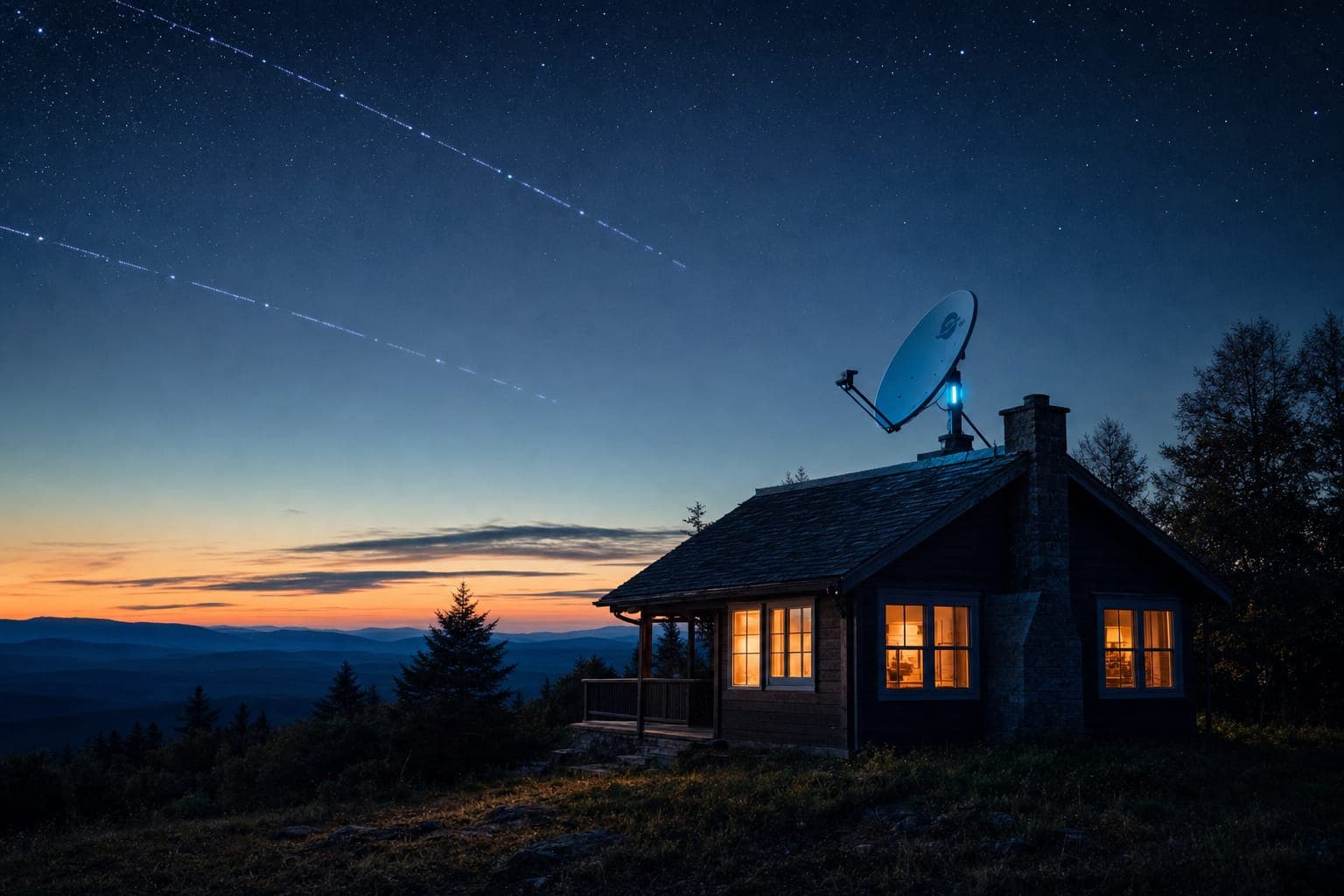
The Punchline of Rural Internet Grew Up
For decades, satellite internet was the broadband of last resort — the thing you endured, not chose. Sluggish speeds, second-long lag, punishing data caps, and weather outages made it a running joke among anyone who'd experienced real broadband. In 2026, that joke has aged badly. Starlink's satellite internet now delivers triple-digit download speeds and latency low enough for competitive gaming, and it does it from a constellation of nearly 9,000 satellites — by far the largest fleet ever put in orbit.
So the question worth asking is no longer "does it work?" It's "is it good enough to choose on purpose?" After digging through performance data, pricing tiers, and the competitive landscape, the answer is a qualified yes — qualified by where you live, what you pay now, and what you need. Let's get into the details.
How Satellite Internet Got Fixed
The old satellite providers — HughesNet, Viasat — parked their satellites in geostationary orbit, roughly 22,000 miles up. That altitude lets one satellite cover a huge area, but physics sends the bill: a round trip of that distance imposes 600 ms or more of latency. Every click, every page load, every video call carried more than half a second of dead air. No engineering cleverness can fix the speed of light.
Starlink's insight was brute-force proximity. Its satellites fly in low Earth orbit at around 340 miles — about 65 times closer. That slashes latency to earthbound levels, but each satellite covers a small patch of ground and screams across the sky in minutes, so you need thousands of them passing the baton constantly. Which is why SpaceX has spent six years launching them at a pace no organization in history has matched, often multiple Falcon 9 flights per week. The same reusable-rocket economics behind that cadence are also opening up private trips to orbit and beyond.
The scale today is hard to overstate. Starlink accounts for the large majority of all active satellites orbiting Earth, serves more than 8 million customers across more than 100 countries, and in January 2026 the FCC authorized SpaceX to deploy thousands of additional next-generation satellites. The constellation isn't finished growing — it's accelerating.
Starlink in 2026: Real-World Speeds and Latency
Marketing numbers are one thing; measured performance is another. Crowdsourced data from Ookla's Speedtest and user reports paint a consistent picture of what satellite internet actually delivers in early 2026:
- Downloads: typically 100 to 250 Mbps for residential users, with quiet-hour peaks higher and congested-cell evenings lower
- Uploads: usually 10 to 25 Mbps — the weakest spot, worth noting if you livestream or push big files to the cloud
- Latency: a median around 26 ms in the US, with most sessions landing between 25 and 50 ms
That latency figure is the headline. It's in the same neighborhood as many cable connections, and it makes video calls, cloud apps, and yes, online gaming, genuinely fine. Geostationary satellite could never say that, and it's the single biggest reason Starlink escaped the "last resort" category.
Caveats remain. Performance is shared per coverage cell, so a rural area that suddenly fills with subscribers can sag until more capacity launches overhead. Heavy storms can briefly degrade the signal. And you need an unobstructed view of the sky — tree cover is the great enemy of the dish. But the difference from five years ago, when early users saw regular dropouts as the sparse constellation left gaps, is night and day.
What It Costs: Plans, Tiers, and Hardware
Starlink's lineup has matured from one-size-fits-all into a real product family. Here's how the main US consumer tiers stack up in early 2026:
| Plan | Monthly price | Best for | Notes |
|---|---|---|---|
| Residential Lite | $50 | Light users in low-demand areas | Deprioritized speeds, not available everywhere |
| Residential | $120 | Rural homes | Unlimited standard data |
| Roam (capped) | $50 and up | Campers, weekenders | Entry data allowance doubled in January 2026 at no extra cost |
| Roam Unlimited | $165 | RVers, nomads, boaters | In-motion use, pause anytime |
Hardware is a one-time purchase: the Standard Kit lists at $349, and the backpackable Starlink Mini — a dish the size of a thick laptop that draws so little power you can run it off a USB battery bank — lists at $249, with frequent regional promotions cutting both prices further. Starlink has also experimented with free or discounted hardware in exchange for service commitments, a sign the company is chasing subscriber growth over equipment margin.
The honest math: $120 a month is more than the average American pays for broadband, and the urban cable or fiber customer can get gigabit service for less. But that comparison misses the point. For households whose alternatives are 10 Mbps DSL, capped geostationary satellite, or nothing, Starlink isn't competing on price — it's competing with not having modern internet at all.
Living With Starlink: The Fine Print
Specs and prices tell you whether Starlink looks good; daily ownership tells you whether it is good. A few realities worth knowing before you order.
Setup is genuinely easy — if your sky cooperates. The kit is self-install: plug it in, let the dish align itself, run the app's obstruction scanner. Most users are online within fifteen minutes. The catch is that obstruction scan. A single mature oak between your dish and the satellites' path can mean micro-dropouts every few minutes — survivable for streaming, maddening for video calls. Wooded properties often end up mounting the dish on a roof peak or a pole at the edge of a clearing, which turns a fifteen-minute setup into a weekend project.
Weather is a smaller deal than skeptics claim, but not nothing. The dish melts snow off its own surface and shrugs off ordinary rain. Genuinely torrential downpours can knock service out for minutes at a time, and heavy cloud cover can shave speeds. Over a typical month, most users report uptime that would embarrass their old DSL line.
Power draw matters off-grid. The standard dish pulls roughly 50 to 75 watts continuously — trivial for a house, meaningful for an RV battery bank or a solar cabin. The Mini's much lower draw is a big part of why it became the de facto choice for mobile and off-grid users.
Support is software-first. There's no technician to call and no local office; troubleshooting happens through the app and support tickets. The flip side is that the network improves continuously without you doing anything — dish firmware, routing, and capacity all upgrade silently, and longtime users report measurably better service today than the day they subscribed, on the same hardware.
Who Should Actually Sign Up
After all the data, the buying decision sorts pretty cleanly:
- Rural households beyond cable and fiber: This is the core case, and it's now close to a no-brainer. If your current options top out below 25 Mbps, Starlink is a generational upgrade.
- RVers, vanlifers, and boaters: Roam plus the Mini dish has quietly become standard equipment for the mobile crowd. The ability to pause service during off months makes the pricing tolerable.
- Remote workers betting on location freedom: A cabin, a ranch, an island — places that were career-incompatible five years ago now support video-call-grade connections.
- Backup connections: Some businesses and prepper-minded households keep a Roam plan dormant as failover for terrestrial outages.
And who shouldn't: anyone with decent cable or fiber available. Wired infrastructure still wins on price, upload speeds, and consistency, and it always will — photons in glass don't have to be launched on a rocket. Suburban users tempted by the novelty should also check 5G home internet first, which we covered in The Future of Mobile Connectivity: Exploring 5G and Beyond Technologies — T-Mobile and Verizon will happily sell you 100-plus Mbps for around $50 a month wherever their towers reach.
Satellite Internet's New Competition: Amazon Leo and Everyone Else
Starlink's biggest validation may be who's chasing it. Amazon's constellation — rebranded from Project Kuiper to Amazon Leo in late 2025 — has put a few hundred production satellites into orbit and is racing an FCC milestone that requires roughly 1,600 satellites deployed by mid-2026, a deadline it has acknowledged it will struggle to hit. Amazon is courting enterprise and aviation customers first, with consumer service still ahead of it, and its deep pockets plus AWS integration make it the one challenger with a plausible path to scale.
But the head start is brutal. Starlink launched its constellation on its own reusable rockets at a cadence Amazon can't yet match, and every month of delay widens a gap measured in thousands of satellites and millions of subscribers. Realistically, Leo's near-term effect will be pricing pressure and enterprise competition rather than a consumer alternative — good news for customers either way.
Meanwhile, the terrestrial threat cuts the other direction. US fiber buildouts continue pushing into smaller towns, and federal broadband funding is slowly wiring communities that were Starlink's natural customers. Starlink's long-term market may actually shrink at the edges even as it grows in absolute terms — a strange dynamic where its strongest competitor is the slow, steady advance of buried glass.
Direct-to-Cell: The Dish Disappears
The most futuristic part of the story doesn't involve a dish at all. Starlink has launched hundreds of direct-to-cell satellites that talk straight to ordinary smartphones — no special hardware, no antenna, just your existing phone finding a signal from space when towers can't reach you.
In the US, this runs through T-Mobile's T-Satellite service, which went commercial in mid-2025 and has expanded from basic texting to location sharing, picture messages, and data for a growing list of approved apps on dozens of phone models. It even works for users on other carriers willing to pay a monthly fee. The bandwidth is tiny compared to the dish — this is for staying reachable on a backcountry trail, not streaming — but as a safety net covering the half-million square miles of US dead zones, it's quietly one of the most consequential telecom launches in years.
It also hints at where this converges with the broader device story we explored in Mobile Tech's Next Big Thing: connectivity that simply exists everywhere, with the network — tower or satellite — abstracted away from the user entirely.
Is Satellite Internet Finally Good Enough? The Verdict
Yes — for the people it's for. That's the honest answer, and it's a remarkable one given where this technology was in 2020.
For the tens of millions of people in rural and remote areas, Starlink in 2026 is not just good enough; it's transformative — real broadband speeds, usable latency, and reliability that has improved steadily as the constellation has thickened. For travelers and nomads, it's become essential infrastructure. For phone users everywhere, direct-to-cell is erasing the concept of "no signal" one satellite at a time.
For everyone else — the majority of readers with cable or fiber at the curb — it remains the wrong tool. It costs more, uploads slower, and asks you to bolt hardware to your roof to get a worse version of what's already in your wall.
The key takeaway: satellite internet stopped being a category of compromise and became a category of coverage. The question in 2026 isn't whether Starlink can match your fiber connection — it can't, and it doesn't need to. It's that the map of places where modern digital life is possible just got dramatically bigger, and it's still growing every launch.