The Question Hiding in Every Prompt
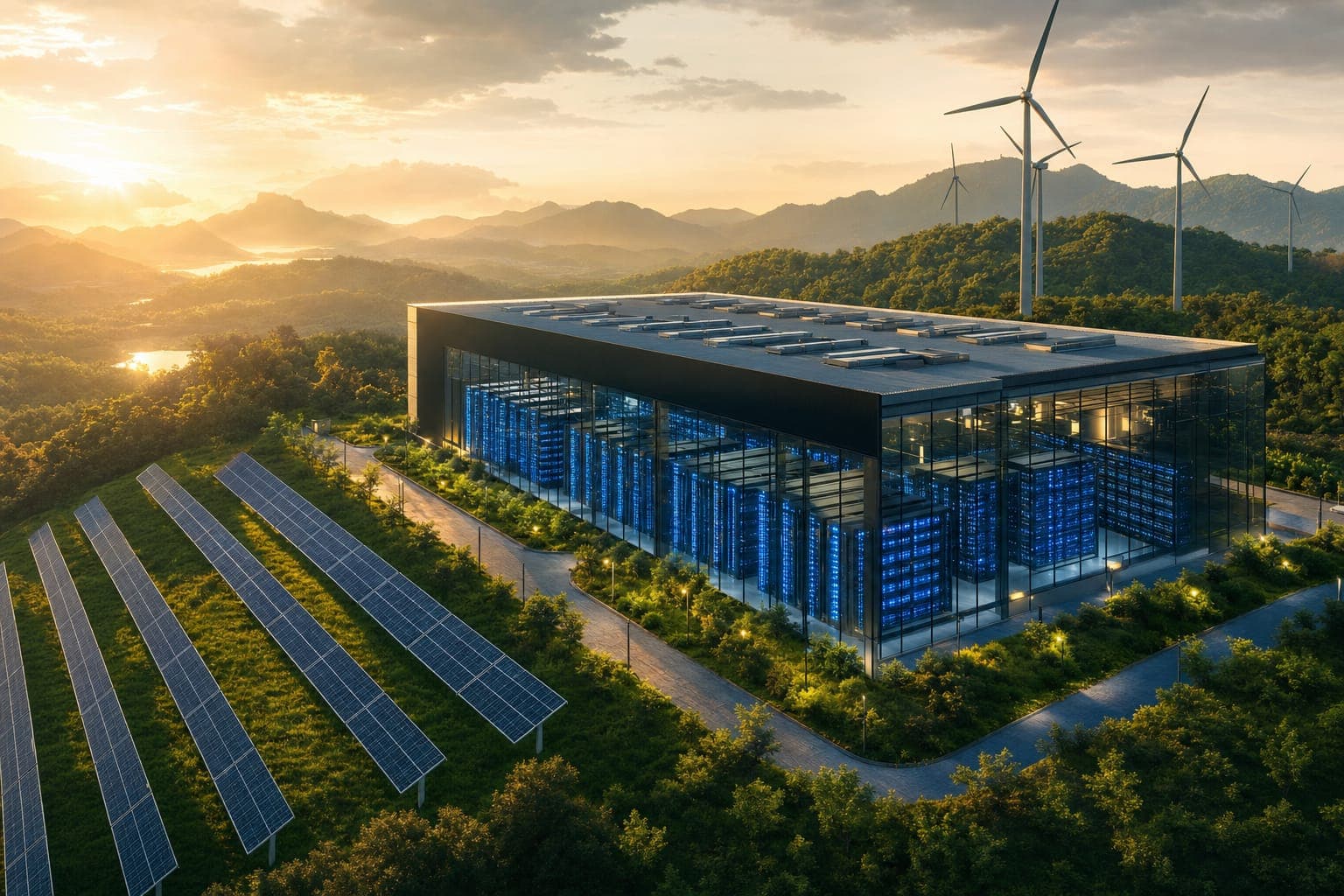
Every time you ask ChatGPT to draft an email, somewhere a rack of GPUs in a warehouse-sized building draws power, sheds heat, and sips cooling water. Multiply that by roughly 2.5 billion prompts a day and you get one of the most contested questions in tech: what is the true environmental cost of AI? Depending on who you ask, it's either a rounding error in your personal carbon footprint or the force that will break power grids by 2030. The honest answer — and the interesting one — is that both framings contain real truth.
This matters more than the usual tech discourse cycle, because the numbers are finally arriving. After years of estimates built on guesswork, OpenAI and Google both published actual figures in 2025, and the International Energy Agency released its first comprehensive analysis of AI's energy demands. We can now do this math with real inputs.
How Much Energy Does a Single ChatGPT Query Use?
In June 2025, Sam Altman put a number on it: the average ChatGPT query consumes about 0.34 watt-hours of electricity and 0.000085 gallons of water — roughly one-fifteenth of a teaspoon, per OpenAI's own disclosure. That's what an oven draws in about one second, or an LED bulb in a couple of minutes. Independent researchers at Epoch AI had estimated roughly 0.3 watt-hours months earlier, which lends the figure some credibility — and notably, both numbers are about ten times lower than the "3 watt-hours per query" claim that circulated for years.
Google went further. In August 2025 it published a methodology showing the median Gemini text prompt uses 0.24 watt-hours, emits 0.03 grams of CO2-equivalent, and consumes about five drops of water — and that the energy per prompt had fallen 33-fold in a single year, according to Google Cloud's analysis.
Two caveats keep these numbers honest. First, "average" hides a wide range: complex reasoning queries with long outputs can burn well over 20 watt-hours, while a short factual question costs almost nothing. Second, critics note these company figures may exclude overhead like networking, idle capacity, and the full water picture, as MIT Technology Review reported. Treat them as a floor, not a ceiling.
Still, for perspective: your individual usage is small. A hundred ChatGPT queries cost about as much electricity as running a microwave for two minutes. An hour of video streaming uses far more. If you want to understand what's actually happening inside those GPUs when you prompt, our explainer How ChatGPT Actually Works: Neural Networks Explained Simply breaks down where all that computation goes.
Training vs. Inference: Where the Energy Really Goes
AI's energy story has two chapters, and they've swapped importance.
Training is the one-time (per model) cost of teaching a neural network from scratch. GPT-4's training run was estimated at around 50 gigawatt-hours — enough to power thousands of homes for a year — and frontier training runs have only grown since. One widely cited academic estimate put the water cost of training GPT-3 alone at roughly 700,000 liters.
Inference — answering queries — costs almost nothing per use but happens billions of times daily. At 2.5 billion prompts a day, ChatGPT's inference draws on the order of 850 megawatt-hours daily, comparable to the annual electricity use of about 29,000 US homes when totaled over a year. Industry analyses now suggest inference accounts for the majority of AI's ongoing energy footprint, flipping the old assumption that training was the main event.
That flip matters for the future: training costs scale with how many frontier models get built, but inference scales with how deeply AI embeds into daily life — search, email, coding, customer service, video generation. The second curve is the one with no obvious ceiling.
The Environmental Cost of AI at Grid Scale
Zoom out from queries to infrastructure and the numbers get serious. The IEA's landmark Energy and AI report found data centers consumed about 415 terawatt-hours in 2024 — around 1.5 percent of global electricity — and projects that figure will more than double to about 945 TWh by 2030, roughly the current electricity consumption of Japan, according to the IEA. That would still be just under 3 percent of global electricity, but the growth is hyper-concentrated: the US and China account for nearly 80 percent of it, and in the United States, data centers are on track to drive almost half of all electricity demand growth through 2030.
Water deserves its own line item. Data centers use water both directly (evaporative cooling) and indirectly (power generation), and large campuses can draw millions of gallons a day in hot climates. Google's US data centers alone consumed billions of gallons in recent years. Per query it's drops; per region, it's a planning problem — especially since data centers cluster in places like Arizona and Texas where water is already contested.
It's worth keeping comparative scale in view, though. Globally, air conditioning uses several times more electricity than data centers, and even the IEA's 2030 projection leaves AI well behind industries nobody writes alarmed headlines about. Your other digital habits offer perspective too: an hour of HD video streaming consumes on the order of 77 watt-hours by common estimates — more than 200 typical ChatGPT queries — and nobody frames a Netflix binge as an environmental crisis. The environmental cost of AI is real and growing fast — but "fast-growing slice of 3 percent" is a different problem than "grid apocalypse," and precision helps us respond sensibly.
The legitimate worry isn't the global total; it's the local concentration. When several gigawatt-scale campuses land on one regional grid in northern Virginia or central Ohio within a few years, transmission lines, water systems, and electricity rates for neighbors all feel it. That's why utilities, not climate scientists, have become the loudest voices in this conversation.
What the Industry Is Actually Doing About It
The most striking response has been Big Tech's sprint toward nuclear power. Microsoft signed a 20-year agreement to restart a reactor at Three Mile Island — rebranded the Crane Clean Energy Center, 835 megawatts, targeted for the late 2020s. Google partnered with Kairos Power on a fleet of small modular reactors totaling 500 megawatts. Amazon committed billions around the Susquehanna nuclear plant, securing nearly 2 gigawatts, and Meta signed a 20-year deal with Constellation for 1.1 gigawatts from Illinois' Clinton plant. Taken together, tech companies have signed contracts for more than 10 gigawatts of US nuclear capacity in barely over a year — a genuine revival of an industry that had been quietly dying.
Efficiency is the quieter, arguably bigger story. Google's 33x per-prompt improvement in twelve months came from better chips, smarter model architectures, and serving optimizations — and there's no sign that curve has flattened. Each GPU generation delivers several times more computation per watt, and techniques like mixture-of-experts models mean most queries no longer activate an entire giant model.
And AI sits on both sides of the ledger. The same IEA report emphasizes AI's potential to optimize power grids, accelerate materials discovery for batteries and solar, and cut industrial waste. We've covered one promising example in AI-Powered Carbon Capture: The Tech Fighting Climate Change — the kind of application that could plausibly offset a meaningful chunk of AI's own footprint, though "could plausibly" is doing real work in that sentence.
Three Scenarios for 2030
Anyone who tells you they know how this plays out is selling something. The IEA itself publishes multiple cases precisely because the uncertainty is enormous. Here are the plausible paths:
Scenario one: efficiency wins. Per-query energy keeps falling 10x or more every couple of years, models get distilled and specialized, and demand growth — while huge — gets absorbed by new clean capacity, much of it nuclear and solar built specifically for data centers. AI's share of global electricity plateaus around 3 to 4 percent. This is roughly the trajectory the optimists at Google and Microsoft are betting their nuclear contracts on.
Scenario two: Jevons paradox bites. Efficiency makes AI so cheap that usage explodes faster than efficiency improves — always-on agents working in the background, video generation going mainstream, AI in every search and email. Falling cost per query has historically increased total consumption, not reduced it. In this world, the IEA's higher "Lift-Off" trajectory materializes, gas plants get life extensions to feed data centers, and emissions targets slip in data center-heavy regions.
Scenario three: the constraint case. Grid interconnection queues, transformer shortages, water permits, and local opposition slow data center buildouts regardless of demand. AI growth gets gated by physical infrastructure, prices for compute rise, and the industry is forced into efficiency and siting discipline earlier than it would choose. There were already signs of this in 2025, with multi-year waits for grid connections in Virginia and Dublin.
Reality will likely braid all three. The honest takeaway: the range of 2030 outcomes spans nearly a factor of two in energy terms, and which path we land on depends on decisions being made right now about siting, procurement, and policy.
What You Can Actually Influence
Here's the part most coverage gets backwards: agonizing over your personal prompt count is the least effective lever you have. Skipping ten ChatGPT queries saves less energy than skipping ten seconds of an electric kettle. If guilt over individual usage is the takeaway, the framing has failed.
What actually moves the needle:
- Where your providers stand. Companies disclosing per-query figures and signing clean-energy contracts respond to customer and press attention. Transparency became a competitive feature in 2025 precisely because people asked.
- Local and policy decisions. Data center siting, utility rate cases, and clean-energy buildouts are decided in public processes. Whether new AI demand gets met with renewables and nuclear or with extended coal and gas plants is a policy outcome, not a law of physics.
- Sensible defaults in your own work. If you build with AI, use the smallest model that does the job — routing simple tasks to lightweight models cuts energy (and cost) by an order of magnitude. Efficiency and your cloud bill point the same direction.
- Keeping perspective elsewhere. Diet, transport, and home heating still dwarf any digital activity in your personal footprint. Our guide Going Green: Tech for a Sustainable Future covers where technology genuinely helps.
The environmental cost of AI is neither a hoax nor a catastrophe — it's an infrastructure challenge arriving on a deadline. The encouraging news is that the incentives mostly align: energy is the AI industry's biggest cost and its biggest constraint, which means the people building it are now among the most motivated buyers of clean power on Earth. The unsettling news is that demand is growing faster than at any point in the modern grid's history, and efficiency gains have a habit of being spent rather than banked.
The key takeaway: judge AI's environmental story not by the watt-hours in your next prompt, but by whether the gigawatts behind it get built clean. That's the number worth watching between now and 2030.