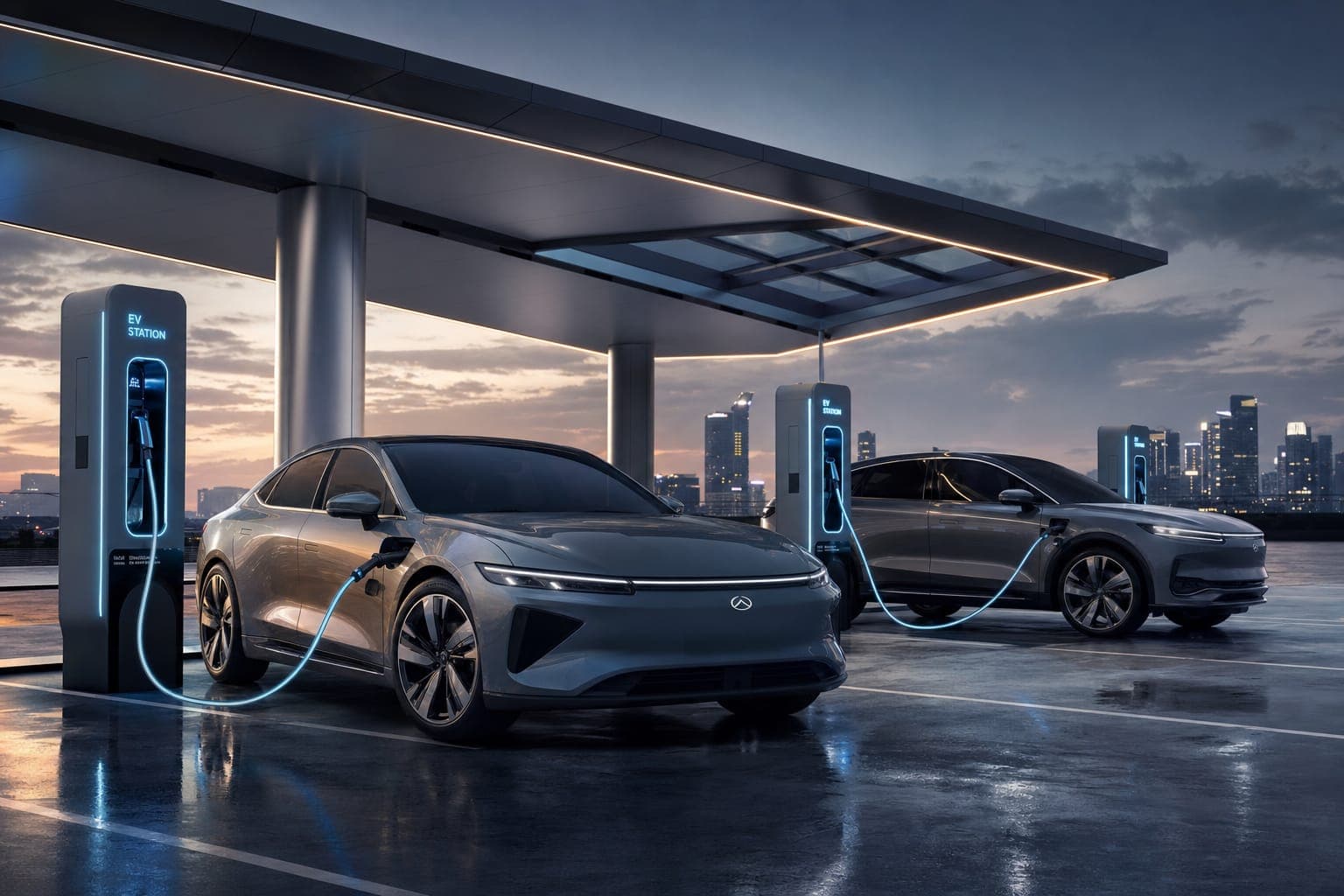
The Strangest Time Ever to Buy an EV — and Maybe the Best
If you're shopping for your first electric vehicle heading into 2026, you've picked a genuinely weird moment. The federal $7,500 tax credit vanished on September 30, 2025, ending a decade-long subsidy era. Yet at almost the same time, prices dropped anyway: Tesla launched stripped-down Standard models under $40,000, Chevy is selling a 319-mile crossover in the mid-$30,000s, and competition from China's BYD has every automaker on the planet sharpening its pencil.
The result is a buyer's market with more genuinely good electric vehicles than ever — and more fine print than ever. This guide walks through what actually matters: range, charging, price brackets, and how Tesla, BYD, and the legacy automakers really compare. Consider it the conversation you'd have with a friend who's been driving electric for years.
First, the Tax Credit Reality Check
Let's rip off the bandage. The federal clean vehicle credit — up to $7,500 for new EVs and $4,000 for used ones — ended for purchases after September 30, 2025. Unlike previous phase-outs, this was a hard stop, and the $1,000 home charger credit expires too.
That doesn't mean incentives are extinct. Several states still offer their own rebates worth a few thousand dollars, many utilities discount home charger installation or offer cheap overnight charging rates, and automakers have responded to the credit's death with their own discounts and subsidized lease deals. Before you shop, spend ten minutes checking your state energy office and your electric utility's website. The money is smaller now, but it's still real.
The silver lining: with the artificial deadline gone, automakers can no longer count on Uncle Sam to close the deal. Price cuts in late 2025 suggest the market is doing what markets do.
Electric Vehicle Range: How Much Do You Actually Need?
Range anxiety is the number one fear of first-time buyers, and it's mostly a solved problem. The average American drives roughly 40 miles a day. Nearly every serious EV on sale today delivers 280 to 330 miles of EPA-rated range — a full week of typical commuting on one charge.
A few practical truths the spec sheets won't tell you:
- Cold weather cuts range, typically 20 to 30 percent in freezing temperatures. If you live in Minnesota, mentally discount every range figure you read.
- Highway speeds drain faster than city driving — the opposite of gas cars. A 300-mile EV is realistically a 240-mile road-trip car at 75 mph.
- You'll rarely charge to 100 percent. Most owners keep the battery between 20 and 80 percent for longevity, so think of usable everyday range as about two-thirds of the headline number.
For most buyers, anything above 280 EPA miles is plenty. Pay for more range only if you regularly take long road trips through sparse charging territory.
Charging: The Question That Matters More Than Range
Here's the advice veteran EV owners give every newcomer: your charging situation matters more than your car choice. If you can charge at home — even on a standard outlet, but ideally with a 240-volt Level 2 charger adding 25 to 40 miles of range per hour — EV ownership is genuinely easier than gas. You wake up "full" every morning and visit public chargers only on road trips.
If you can't charge at home or at work, think hard before buying. Public-charging-only ownership is doable but erodes both the convenience and the cost savings.
The public network itself just got dramatically better. Through 2024 and 2025, virtually every automaker selling in North America adopted Tesla's NACS plug and gained access to the Supercharger network — the largest and most reliable fast-charging system in the country. New models like the 2026 Hyundai Ioniq 5 now ship with a native NACS port, no adapter required.
Charging speed varies more than buyers expect. The Ioniq 5's 800-volt architecture goes from 10 to 80 percent in about 18 minutes on a powerful charger; the Chevy Equinox EV's 400-volt system takes roughly 40 minutes for the same fill. If road trips are your life, that difference compounds.
Electric Vehicle Price Brackets in 2026
The market now splits into three useful tiers.
Under $40,000 — the new battleground. This is where the action is. Tesla's Model 3 Standard at $36,990 and Model Y Standard at $39,990, both launched in October 2025 with about 321 miles of range, compete directly with the Chevy Equinox EV (from about $35,000, 319 miles) and the repriced Ioniq 5. Be aware Tesla cut real features to hit those prices — the Standards drop Autopilot, among other things.
$40,000 to $55,000 — the sweet spot. Here you'll find well-equipped versions of the Ford Mustang Mach-E, Hyundai Ioniq 5 and Kia EV6, VW ID.4, Tesla's Premium trims, and Chevy's Blazer EV. More range, all-wheel drive, faster charging, nicer interiors.
Above $55,000 — trucks and luxury. Electric pickups like the Ford F-150 Lightning and Chevy Silverado EV, plus premium entries from Cadillac, BMW, Mercedes, Rivian, and Lucid. Excellent vehicles, but first-time buyers rarely need to start here.
Here's how representative models compare:
| Model | Starting price (approx.) | EPA range (max trim shown) | Fast charging | Plug |
|---|---|---|---|---|
| Tesla Model 3 Standard | $36,990 | 321 mi | ~250 kW, Supercharger access | NACS |
| Tesla Model Y Standard | $39,990 | 321 mi | ~250 kW, Supercharger access | NACS |
| Chevy Equinox EV | $34,995 | 319 mi | 150 kW (10-80% in ~40 min) | CCS (NACS adapter) |
| Hyundai Ioniq 5 | ~$35,000 | up to 318 mi | 350 kW (10-80% in ~18 min) | Native NACS |
| Ford Mustang Mach-E | ~$38,000 | up to 320 mi | 150 kW | CCS (NACS adapter) |
| VW ID.4 | ~$45,000 | up to 291 mi | 175 kW | CCS (NACS adapter) |
| BYD Seal (not sold in US) | varies by market | ~300 mi (WLTP-based est.) | 150 kW | varies by market |
Tesla vs BYD vs the Legacy Pack
Tesla remains the default answer for a reason: the Supercharger network, best-in-class software and over-the-air updates, strong efficiency, and now genuinely competitive entry prices. The trade-offs are real too — build quality varies, the Standard trims are noticeably decontented, service can be hit-or-miss, and the brand itself has become polarizing in ways that affect resale conversations at dinner parties.
BYD is the elephant not in the room. The Shenzhen giant pulled ahead of Tesla in global pure-electric sales during 2025, building a lead of nearly 400,000 vehicles through early October, on the strength of vertically integrated batteries and aggressively priced models like the Seal sedan and Atto 3 crossover. Here's the catch for American readers: BYD passenger cars aren't sold in the United States, walled off by tariffs that exceed 100 percent. If you're in Europe, Latin America, Australia, or Southeast Asia, BYD belongs on your shortlist for sheer value. In the US, BYD matters mainly as the competitive pressure forcing everyone else's prices down.
The legacy automakers have quietly become the value play. GM's Ultium-based lineup — Equinox, Blazer, Silverado — paired strong range with sane pricing in 2025. Hyundai and Kia arguably build the best-engineered mainstream EVs on sale, with 800-volt charging the Germans charge luxury prices for. Ford offers the most conventional ownership experience and a dealer on every corner, though its EV strategy has been openly retrenching toward cheaper future models. VW's ID.4 is competent if unexciting. The legacy advantage: established dealer service networks, familiar ergonomics, and deep discounts as they fight for share.
What to Check Before You Sign
A short pre-purchase checklist that will save you real money and grief:
- Test your charging plan first. Confirm you can install a Level 2 charger (renters: get landlord approval in writing), and price the installation — typically $500 to $2,000 depending on your electrical panel.
- Check the battery warranty. Federal rules require 8 years or 100,000 miles on the battery; some makers go further. For used EVs, ask for a battery health report.
- Map your road-trip routes in an app like PlugShare or A Better Routeplanner before buying, not after. Charging deserts still exist.
- Run the insurance quote early. EVs often cost 10 to 20 percent more to insure.
- Scrutinize lease deals. With the federal credit gone, automakers are stuffing incentives into leases — sometimes making leasing unusually attractive, especially given how fast EV tech is improving.
- Don't pay for range you won't use. The $8,000 step up to a bigger battery rarely pays off for a commuter.
The Math: What an EV Actually Saves You
With the federal credit gone, the ownership economics deserve a fresh look — and they still favor electric for most drivers, just on a longer timeline.
Charging at home typically costs the equivalent of paying $1 to $1.50 per gallon of gasoline, depending on your electricity rates, and overnight EV tariffs from many utilities push that lower. A driver covering 12,000 miles a year commonly saves $800 to $1,200 annually on fuel alone versus a comparable gas crossover. Public fast charging is far pricier — sometimes approaching gas-car costs per mile — which is one more reason the home-charging question dominates everything else.
Maintenance tilts the same direction. No oil changes, no transmission service, no exhaust system, and regenerative braking that can stretch brake pads past 100,000 miles. Studies consistently put EV scheduled maintenance at roughly 40 percent less than internal combustion. The honest counterweights: depreciation on EVs has run steeper than average as prices fell and tech improved quickly, insurance runs higher, and a few states now charge EV registration fees to recoup lost gas taxes. Run your own ten-minute spreadsheet with local electricity and gas prices before deciding — the answer varies more by ZIP code than by car.
The Bigger Picture
Stepping back from spec sheets: transportation produces more greenhouse gas emissions than any other sector of the US economy, and electrifying it is among the highest-leverage climate moves an individual can make — even on today's grid, an EV produces substantially less lifetime CO2 than a comparable gas car, and it gets cleaner every year as the grid does. We've covered that broader transition in Going Green: Tech for a Sustainable Future, and the grid-cleaning technologies that compound an EV's benefits in AI-Powered Carbon Capture: The Tech Fighting Climate Change.
There's also a quieter perk nobody mentions at the dealership: an EV is the biggest smart device you'll ever own. Scheduled charging during cheap overnight rates, preconditioning the cabin from your phone, and over-the-air updates that genuinely improve the car fit naturally into the connected home we described in Living the Smart Life: IoT and Home Tech.
The Takeaway
The death of the federal tax credit looked like a setback for electric vehicles, but the market's response — Tesla under $40,000, a 319-mile Chevy in the mid-$30,000s, BYD forcing global price discipline — has arguably left buyers better off than the subsidy era did. The technology is mature, the charging plug wars are over, and the choices are real.
Your move as a first-time buyer is simple: sort out home charging before anything else, buy the range you'll actually use rather than the range that soothes your anxiety, and cross-shop at least one Tesla, one Korean entry, and one GM product before deciding. Do that, and 2026 might be the best year yet to go electric.