The Robot Vacuum Market Has Never Been Better — or More Confusing
Buying a robot vacuum in 2026 means choosing from a market that spans $150 to $2,500, where a flagship now ships with a robotic arm that picks socks up off your floor, and where features that cost $800 three years ago — LIDAR navigation, self-emptying docks — have quietly trickled down to models under $300. It's a great time to buy and a genuinely confusing one, which is exactly why this robot vacuum buyer's guide exists.
The short version: the technology has matured to the point where the question is no longer "do robot vacuums actually work?" They do. The question is which 20 percent of the feature list you should actually pay for — and which expensive extras are solving problems you don't have. Let's sort it out.
How Robot Vacuums Navigate in 2026: LIDAR vs. Cameras
Navigation is the single biggest quality divider between cheap and good, so it's worth understanding before you look at a single product page.
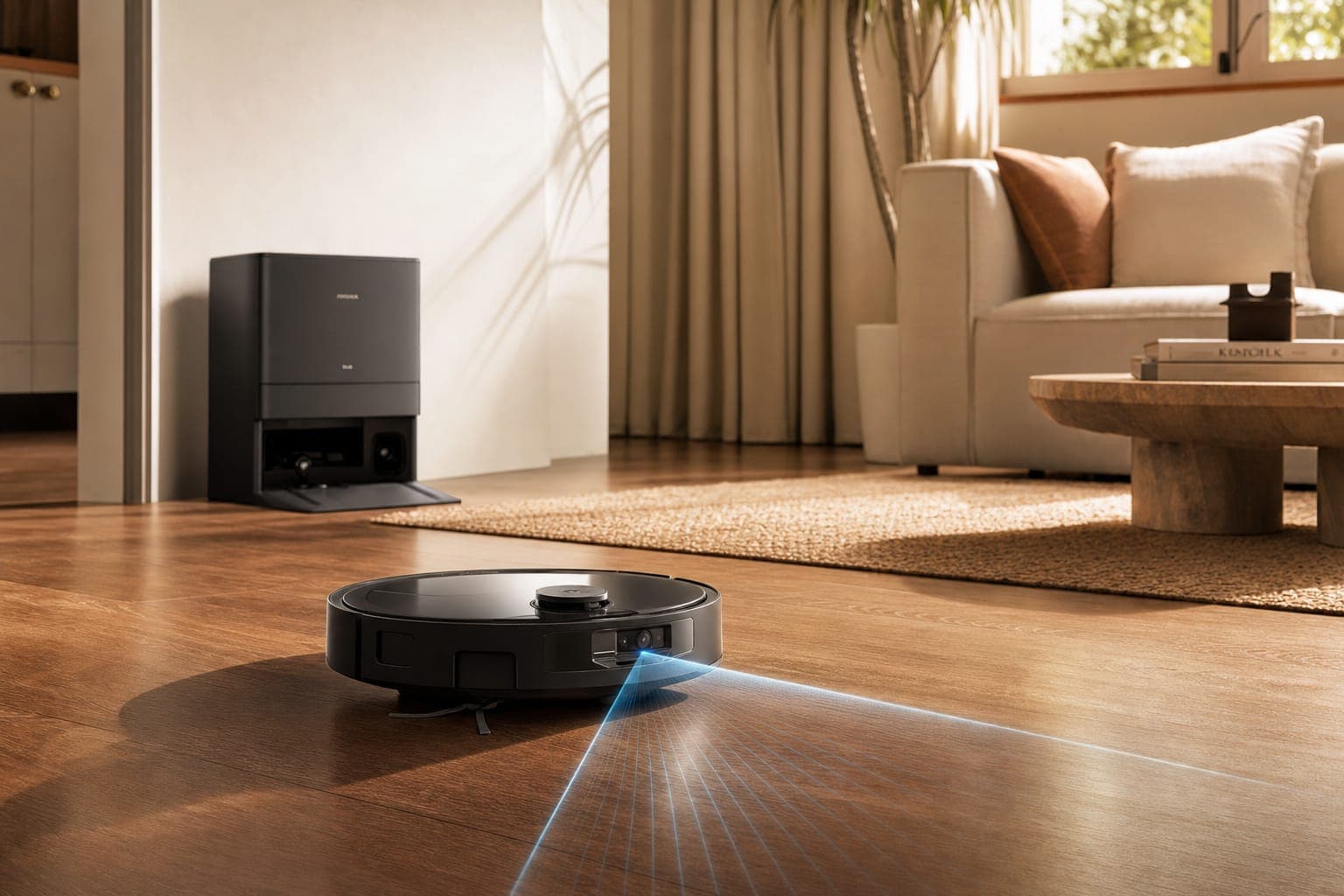
LIDAR (laser navigation) is the gold standard in 2026 and, remarkably, now available on models under $250. A spinning laser turret maps your rooms in minutes, works in total darkness, and produces the tidy floor plans that make app features — no-go zones, room-by-room cleaning — actually reliable. Even iRobot, the last major holdout, moved its flagship Roomba line to LIDAR with the Max 705 series.
Camera-based navigation (VSLAM) uses an upward- or forward-facing camera to track position. It works, but it needs decent lighting and tends to wander more. In 2026 it survives mainly on older budget models — and as a supplement on premium bots, where front cameras power AI obstacle recognition.
Gyroscope/bump navigation is what you get under roughly $150: semi-random coverage, no real map. Fine for a small studio, maddening in a real house.
Then there's AI obstacle avoidance, the feature that separates today's flagships. Using cameras or structured light, premium bots identify and steer around shoes, cables, and — critically for pet owners — dog accidents. The current benchmark is the Roborock Saros 10R, the only robot to post a perfect score in Vacuum Wars' 24-object obstacle course. If you have kids or pets leaving an unpredictable floor, this feature is worth real money. If your floors are usually clear, it's a luxury.
Docks, Mops, and the Rise of the Hands-Free Machine
The second big evolution is the dock. A modern robot vacuum is really a two-part system, and the dock now does most of the work that used to be your job:
- Self-empty docks vacuum the robot's small bin into a sealed bag holding 30–60 days of debris. Once a premium add-on, these now appear on budget models around $280–$300. For most buyers this is the single highest-value upgrade — it's the difference between owning a robot and babysitting one.
- Self-wash docks are for mopping hybrids: they wash the mop pads with clean water, dry them with heated air to prevent mildew, and refill the robot's tank. Flagship versions add hot-water washing and automatic detergent dosing.
- Combo docks do all of the above in one (large) tower. Expect to surrender a doormat-sized patch of floor and a power outlet.
On mopping itself, be realistic. Spinning-pad and vibrating-pad hybrids from Roborock, Dreame, and Eufy genuinely maintain hard floors, removing light grime and dried spills — reviewers found iRobot's Roomba Max 705 Combo gets close to a manual mop on sealed hard floors. None of them will scrub a winter's worth of mudroom grime. Think "keeps clean floors clean," not "replaces the mop bucket entirely." Models that lift or detach their mop pads automatically are worth prioritizing if you have rugs and carpet mixed in with hard floors.
A quick note on specs: brands love advertising suction in pascals — 8,000 Pa, 13,000 Pa, ever upward. Past roughly 5,000 Pa, brush design and airflow matter more than the headline number. An anti-tangle rubber brush that doesn't wrap hair into a rope will do more for you than another 3,000 Pa.
The Brands That Matter in 2026
Five names dominate the conversation, each with a distinct personality.
Roborock is the current technology leader. Its Saros line tops most 2026 rankings, and the Saros Z70 made headlines as the first mainstream robot with a folding robotic arm that lifts light obstacles out of its path. Reviewers' consensus: a fascinating glimpse of the future, but experimental relative to its ultra-premium price. The mid-range Q series remains one of the best value lines going.
Dreame has surged into the premium tier; its X60 Max Ultra Complete is Vacuum Wars' current best-overall pick, with elite obstacle avoidance and a superb wash-dry dock. If Roborock is the flashy innovator, Dreame is the polished executor.
iRobot (Roomba) is the legacy giant in transition. After a rocky stretch — the collapsed Amazon acquisition in 2024 and well-publicized financial strain — the company rebooted its lineup with the Max 705 series: LIDAR navigation at last, 13,000 Pa suction, dual anti-tangle rubber brushes, and unusually aggressive pricing, with the Max 705 Combo launching at $899 and frequently discounted hundreds below that within months. The hardware is genuinely competitive again; the open question is the company's long-term footing.
Eufy (Anker) owns the value tier. The L60 delivers LIDAR and 5,000 Pa suction under $250, the E20 and E25 Omni anchor the midrange, and the ancient-but-beloved RoboVac 11S Max still serves tiny apartments for around $140.
Shark is the dependable dark horse — strong vacuum-first engineering, good self-empty docks, frequent sales, and less app sophistication than the Chinese flagships. A solid pick if you want a known retail brand with easy returns and don't care about cutting-edge mopping.
Robot Vacuum Buyer's Guide by Budget: What Your Money Gets
Here's the 2026 market in one table, with representative picks at each tier:
| Tier | Price range | What you get | Representative picks |
|---|---|---|---|
| Entry | $140–$250 | LIDAR mapping, 5,000+ Pa suction, app control, basic mopping pad | Eufy L60, MOVA S10, Eufy 11S Max (gyro) |
| Budget plus | $250–$450 | LIDAR plus self-empty dock; anti-tangle brushes | Tapo RV30 Max Plus, Eufy E20, Roborock Q7 L5 |
| Midrange | $450–$900 | Strong AI obstacle avoidance, real mopping with pad lift, better docks | Eufy E25 Omni, Roomba Max 705 (Vac or Combo) |
| Premium | $900–$1,600 | Hot-water mop washing, drying, auto-refill, top-tier navigation | Dreame and Roborock upper mid-flagships |
| Ultra-flagship | $1,600–$2,500 | Everything above plus frontier features: robotic arms, climbing chassis | Roborock Saros Z70, Saros 10R, Dreame X60 Max Ultra |
Our honest spending advice for most households: the $250–$900 band is the sweet spot. Below it you give up the dock conveniences that make ownership effortless; above roughly $900 you're paying steeply for mopping automation and frontier party tricks. The jump from a $200 bot to a $500 bot transforms the experience. The jump from $900 to $2,000 mostly transforms the spec sheet.
Three features are worth insisting on at any budget: LIDAR navigation, an anti-tangle brush if anyone in your home has long hair or sheds (pets count), and a self-empty dock unless you genuinely enjoy emptying a palm-sized bin every two days.
And a few features you can comfortably skip in 2026: voice assistants built into the robot itself (your phone already does this), "dirt detection" marketing modes that mostly just slow the robot down, and remote video patrol on bots you bought for cleaning. Robotic arms and leg-lifting climbing chassis are genuinely impressive engineering — and genuinely not worth a four-figure premium for most homes yet.
Budget a little for upkeep, too. Dock bags run a few dollars each, filters and brushes want replacing every few months, and mop pads wear out. Figure $40–$80 a year in consumables for a docked machine — trivial against the time saved, but worth knowing before the subscription-like reality sets in.
The Privacy Question: A Camera That Drives Around Your House
This deserves its own section, because a camera-equipped robot vacuum is exactly what it sounds like: a connected, mobile camera that maps your home and phones data to the cloud.
The risk isn't theoretical. In 2024, attackers exploited flaws in Ecovacs robots to take over units in US homes — watching through cameras, harassing residents through speakers. More recently, a South Korean consumer agency found security holes in models from Narwal, Ecovacs, and Dreame, including cleaning photos accessible to third parties. Vendors patched the disclosed flaws, but the pattern is clear: this product category's security maturity lags its hardware ambition.
Sensible precautions, in order of effort:
- Prefer LIDAR-only models if cameras make you uneasy. A laser map of your wall locations is far less sensitive than video. Many excellent bots, including Roomba's Max 705 Vac, navigate without a forward camera.
- Check for physical indicators and shutters. Better camera-equipped bots light an LED whenever video is active.
- Keep firmware updated and use a strong, unique app password with two-factor authentication where offered. Most real-world compromises exploited unpatched or poorly authenticated devices.
- Put it on your IoT network segment if you've set one up — the same hygiene we recommend in Living the Smart Life: IoT and Home Tech.
None of this should scare you off the category. It should just inform which model you choose and how you set it up.
Where This Is All Heading
Zoom out and the robot vacuum is quietly becoming something bigger: the first mass-market autonomous robot, with over a decade of navigation, mapping, and obstacle-avoidance refinement behind it. The Saros Z70's grabber arm is a gimmick today — and an unmistakable signal of where home robotics goes next, a trajectory we explored in Humanoid Robots: Tesla Optimus and the Future of Labor and in Robots at Home and in the City: Are We Ready for an Automated World?. The companies perfecting sock-avoidance in 2026 are building the spatial intelligence that tomorrow's home robots will run on.
For buyers, the practical outlook is friendlier: this market improves fast and depreciates faster. Last year's flagship features reliably show up in this year's midrange, and deep discounts arrive within months of launch — as the Roomba Max 705's rapid price cuts showed. Buying one tier below the bleeding edge is consistently the smart money.
The key takeaway: in 2026, a great robot vacuum costs $250–$900, navigates with LIDAR, empties itself, and refuses to eat your charging cables. Spend on navigation and the dock, be skeptical of suction numbers and robotic arms, treat camera-equipped models like the connected devices they are — and let last year's flagship, at this year's discount, do your vacuuming forever.