The Console You Don't Have to Buy
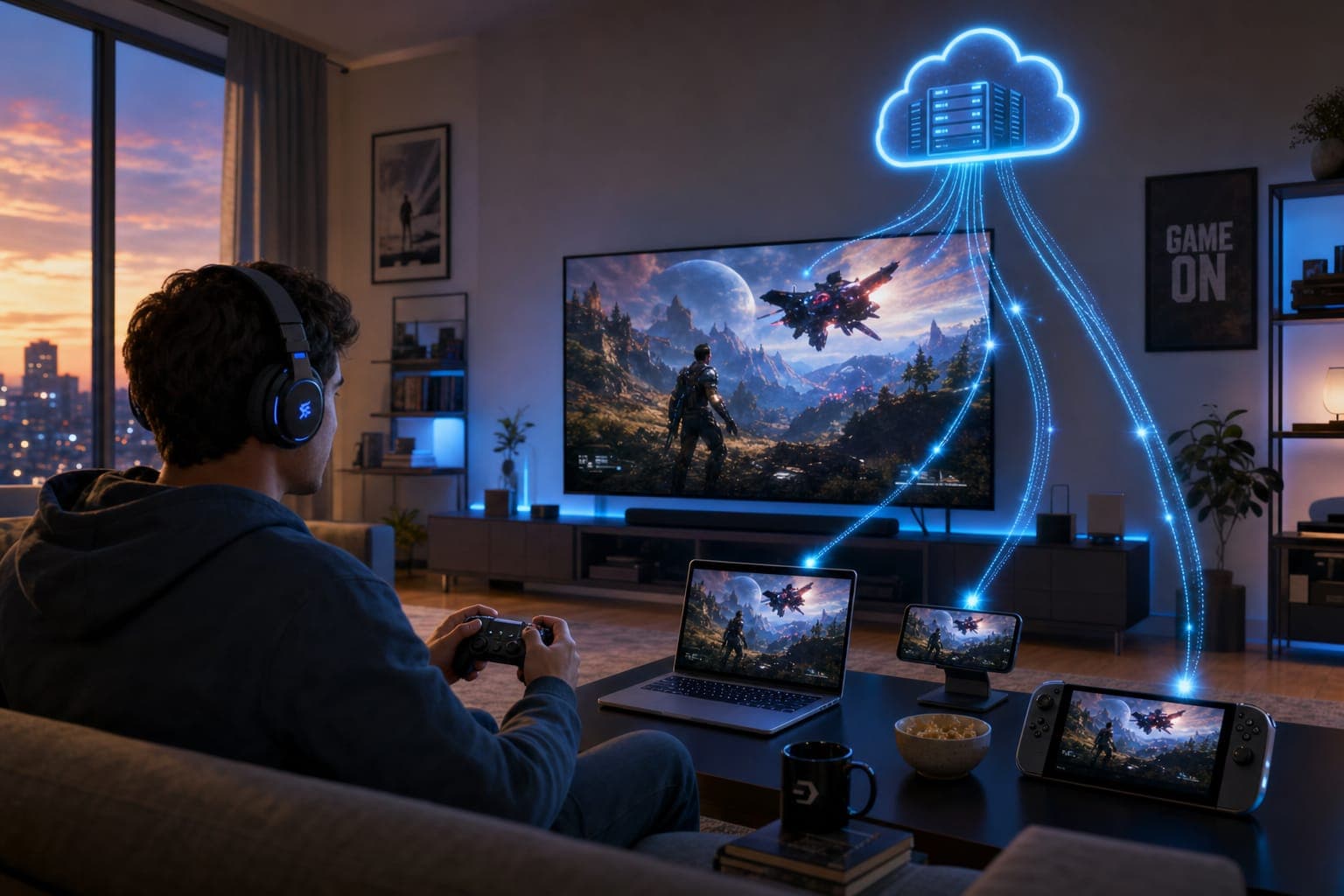
Somewhere between Google Stadia's funeral in 2023 and today, cloud gaming quietly stopped being a punchline. In 2026, you can stream Cyberpunk 2077 with path tracing to a five-year-old laptop, play Starfield on your phone during a commute (a solid pair of wireless headphones makes all the difference), and run a AAA library on a smart TV with nothing but a Bluetooth controller. The technology works. The harder question now is which cloud gaming service deserves your money — because Xbox Game Pass, NVIDIA GeForce Now, and PlayStation Plus Premium are playing three completely different games.
That's not an exaggeration. Microsoft sells you a Netflix-style library. NVIDIA rents you a monster gaming PC and lets you bring the games you already own. Sony treats streaming as a bonus feature bolted onto its subscription catalog. And Amazon Luna, the perennial wildcard, has reinvented itself as the casual option bundled into Prime. Pick wrong and you'll either overpay or underplay.
Why Cloud Gaming Finally Works in 2026
Two things changed since the Stadia era. First, the infrastructure caught up. NVIDIA spent 2025 rolling out RTX 5080-class SuperPODs that push up to 5K resolution at 120 frames per second, with a competitive mode that hits 360 fps at 1080p. NVIDIA claims click-to-pixel latency under 30 milliseconds on its top tier in well-served regions — a number that would have sounded like fantasy in 2020.
Second, the business models matured. Nobody is asking you to buy games at full price that live exclusively in someone else's data center anymore (the original sin of Stadia). Today's services either bundle streaming into subscriptions you might already have, or stream games you purchased on Steam, Epic, and other stores you'd use anyway.
The result: cloud gaming has gone from "neat demo" to a legitimate answer to the question "do I really need a $500-plus console or a $2,000 gaming PC?" For a lot of people in 2026, the honest answer is no — and that's a genuinely new development. If you're curious how we got from laggy experiments to this, the groundwork was laid by faster networks; our look at The Future of Mobile Connectivity: Exploring 5G and Beyond Technologies explains why low-latency wireless made phone and tablet streaming viable at all.
Xbox Cloud Gaming: The Netflix Model, Now on Every Paid Tier
Microsoft restructured Game Pass in late 2025, and the big news for streamers is that cloud play is no longer locked to the most expensive plan. The lineup now looks like this:
- Essential ($9.99/month): a rotating catalog of around 50 games, online console multiplayer, and — crucially — cloud streaming of that catalog.
- Premium ($14.99/month): roughly 200 games with cloud access, plus new Xbox-published titles within about a year of launch.
- Ultimate ($29.99/month): 400-plus games with day-one first-party releases, EA Play, Ubisoft+ Classics, Fortnite Crew, and the highest streaming quality — now up to 1440p, a welcome bump from the 1080p ceiling that lingered for years.
Ultimate also lets you stream a growing list of games you own outright, even ones that aren't in the catalog, which blunts one of GeForce Now's traditional advantages. Microsoft has additionally been testing a free, ad-supported streaming tier with Xbox Insiders — a sign of where it wants this to go.
Device support is the broadest in the business: browsers, Android, iOS (via web app), Windows, Samsung and LG smart TVs, Amazon Fire TV sticks, and Meta Quest headsets. The catch? Streams come from Xbox Series X server blades, so you're getting console-grade visuals, not high-end PC settings, and resolution still tops out below what NVIDIA offers.
Best for: people who want maximum games for minimum decisions. You press play; Microsoft handles everything else.
GeForce Now: Rent the Hardware, Bring Your Own Library
NVIDIA's pitch is the opposite of Microsoft's. GeForce Now includes almost no games — instead, it streams the PC games you already own on Steam, Epic Games Store, Ubisoft Connect, GOG, Battle.net, and Xbox/PC Game Pass. More than 4,500 titles are supported, and the Install-to-Play feature introduced in late 2025 lets you install many Steam games that aren't formally onboarded, pushing the practical library far higher.
The tiers:
- Free: ad-supported, basic rigs, one-hour sessions, and queues that can sting at peak times. A real trial, not a real home.
- Performance ($9.99/month): RTX-class servers, up to 1440p at 60 fps, longer sessions, priority access.
- Ultimate ($19.99/month): RTX 5080-class rigs, up to 5K at 120 fps (or 360 fps at 1080p), DLSS 4, ray tracing, and 8-hour sessions.
One significant change for 2026: paid tiers now include 100 hours of monthly playtime, with modest rollover and extra 15-hour blocks available for around $6. That's more than three hours a day — fine for most adults, a genuine constraint for heavy players who treat streaming as their only platform.
The quality ceiling here is simply unmatched. On a fast connection, Ultimate is the closest thing to owning a $2,000-plus GPU without owning one. It runs on PC, Mac, phones, tablets, LG and Samsung TVs, and even Steam Deck via a native app. The trade-off is friction: you're buying games at market price, launching storefronts inside a stream, and occasionally discovering a publisher has pulled its catalog from the service.
Best for: PC gamers with existing Steam libraries, and anyone who cares about image quality and latency above all else.
PlayStation Plus Premium: Streaming as a Side Dish
Sony's approach is the most conservative of the three. Cloud streaming exists only inside the top tier of PlayStation Plus — Premium, at $19.99/month or $159.99/year — and it's framed as a perk, not a platform.
What you actually get is substantial, though. Premium streams hundreds of PS5 and PS4 catalog titles at up to 4K with HDR, plus a Classics Catalog that includes PS3 games playable nowhere else (those PS3 titles are stream-only, a quiet miracle of emulation avoidance). Time-limited trials of select new releases round it out.
The limitation is where you can play. Streaming works on PS5 and PS4 consoles, PC, and the PlayStation Portal handheld — which gained full cloud streaming out of beta in late 2025 and transformed from "expensive Remote Play accessory" into a legitimate standalone cloud device. There's no phone app, no smart TV app, no browser play. Sony clearly sees streaming as a way to keep PlayStation owners inside the ecosystem, not a way to reach people without Sony hardware.
Best for: existing PlayStation households, Portal owners, and anyone who wants to revisit PS3-era classics legally.
Amazon Luna: The Sleeper Bundled Into Prime
Luna spent years as an afterthought, then got a genuine overhaul in late 2025. The service is now bundled with Amazon Prime — Prime members in 14 countries get a rotating selection of 50-plus games at no extra cost, headlined by GameNight, a couch-multiplayer collection where friends use their phones as controllers via QR code. A Luna Premium tier at $9.99/month adds a deeper catalog.
Luna won't satisfy anyone reading spec sheets — its quality and library trail the big three. But as a zero-extra-cost option already sitting inside a subscription that more than 100 million households pay for, it's the easiest possible on-ramp to cloud gaming. For family game nights on a Fire TV, it's quietly excellent.
Cloud Gaming Comparison: The Big Four Side by Side
| Service | Streaming price | Max stream quality | Library model | Key devices | Recommended internet |
|---|---|---|---|---|---|
| Xbox Cloud Gaming | $9.99–$29.99/mo | Up to 1440p (Ultimate) | Included catalog, 50–400+ games | Browser, phones, TVs, Fire TV, Quest | 10 Mbps min, 20+ ideal |
| GeForce Now | Free–$19.99/mo | Up to 5K/120 fps or 360 fps | Bring your own (4,500+ supported) | PC, Mac, phones, TVs, Steam Deck | 25 Mbps for 1080p, 45 for 4K |
| PS Plus Premium | $19.99/mo | Up to 4K HDR | Included catalog + PS3 classics | PS5/PS4, PC, PS Portal | 5 Mbps min, 15 for 1080p, ~38 for 4K |
| Amazon Luna | Prime or $9.99/mo | Up to 1080p (4K select) | Included rotating catalog | Fire TV, browser, phones, smart TVs | 10 Mbps, 25 for highest quality |
Prices and tiers as of March 2026; all four services adjust offerings frequently, so check current terms before subscribing.
What Cloud Gaming Demands From Your Internet
Here's the part marketing pages underplay: bandwidth is the easy requirement. Almost any modern connection clears 25 Mbps. What actually determines whether cloud gaming feels great or unplayable is latency, jitter, and packet loss — a 50 Mbps fiber connection with a 15 ms ping will beat a 500 Mbps cable line with an 80 ms ping every single time.
Practical rules of thumb for 2026:
- Wired beats wireless. Ethernet or at minimum Wi-Fi 6/6E on the 5 GHz or 6 GHz band. Streaming over congested 2.4 GHz Wi-Fi is the number-one cause of "cloud gaming is bad" opinions.
- Distance to servers matters. Independent testing consistently shows GeForce Now averaging total input latency meaningfully lower than Xbox Cloud Gaming — roughly 25–40 ms versus 40–60 ms network latency in well-covered metro areas — but both degrade fast if you're far from a data center.
- Genre matters more than specs. Turn-based games, RPGs, and platformers feel native on every service. Competitive shooters and fighting games remain the cloud's weakest case, though GeForce Now's 360 fps mode narrows the gap surprisingly well.
If your home internet is solid, the experience in 2026 is genuinely good. If it isn't, no subscription tier will save you.
So Which One Should You Pick?
Pick Xbox Game Pass if you want the most content for the least thought. Essential at $9.99 is the cheapest real cloud gaming on the market, and Ultimate remains the best all-you-can-eat deal in gaming despite its price — day-one releases alone can justify it.
Pick GeForce Now if you already own PC games or care about fidelity. Performance at $9.99 is the value sweet spot; Ultimate is for people who want 4K-plus ray-traced visuals without buying the GPU. Just budget for buying games separately and mind the 100-hour cap.
Pick PlayStation Plus Premium if you're already in Sony's world — especially if you own a Portal or have PS3 nostalgia. As a standalone cloud service for non-PlayStation owners, it's hard to recommend; the device restrictions are too tight.
Use Luna if you have Prime, because you're already paying for it. It's the best "didn't know I had this" perk in tech right now.
And don't sleep on combinations. GeForce Now streaming your PC Game Pass library merges Microsoft's catalog with NVIDIA's hardware — arguably the single best cloud setup in 2026 if you're willing to pay for both. Cloud streaming is also creeping into adjacent spaces, from VR headsets (Xbox Cloud on Meta Quest is further along than the skeptics expected — see our 8 Interesting Facts About Virtual Reality) to user-generated worlds where creation itself is the draw, as in the community scenes we covered in Creating Great Minecraft Maps.
The key takeaway: there's no single winner, because these services aren't really competing on the same axis. Game Pass sells a library, GeForce Now sells hardware, PlayStation sells loyalty, and Luna sells convenience. Decide which of those four things you actually lack — then the choice mostly makes itself.