The Year Quantum Stopped Being a Promise
For two decades, quantum computing has been the technology that's perpetually ten years away. In 2026, that joke is finally getting stale — because the ten years are visibly running out. Google's Willow chip demonstrated error correction that improves as you add qubits, IBM says it's on track to demonstrate verified quantum advantage by the end of 2026, and you can run circuits on real quantum processors today from your laptop, some of them for free.
None of this means a quantum computer is about to replace your MacBook. It isn't, and it never will — quantum machines are specialized accelerators, not general-purpose computers. But the gap between laboratory milestone and usable tool has narrowed dramatically since we covered quantum computing breaking out of the lab last year. Here's an honest accounting of where things stand.
Quantum Computing's Big Three Milestones
Three announcements define the current era, and each attacks the field's central problem: qubits are fragile, and errors compound faster than useful computation can finish.
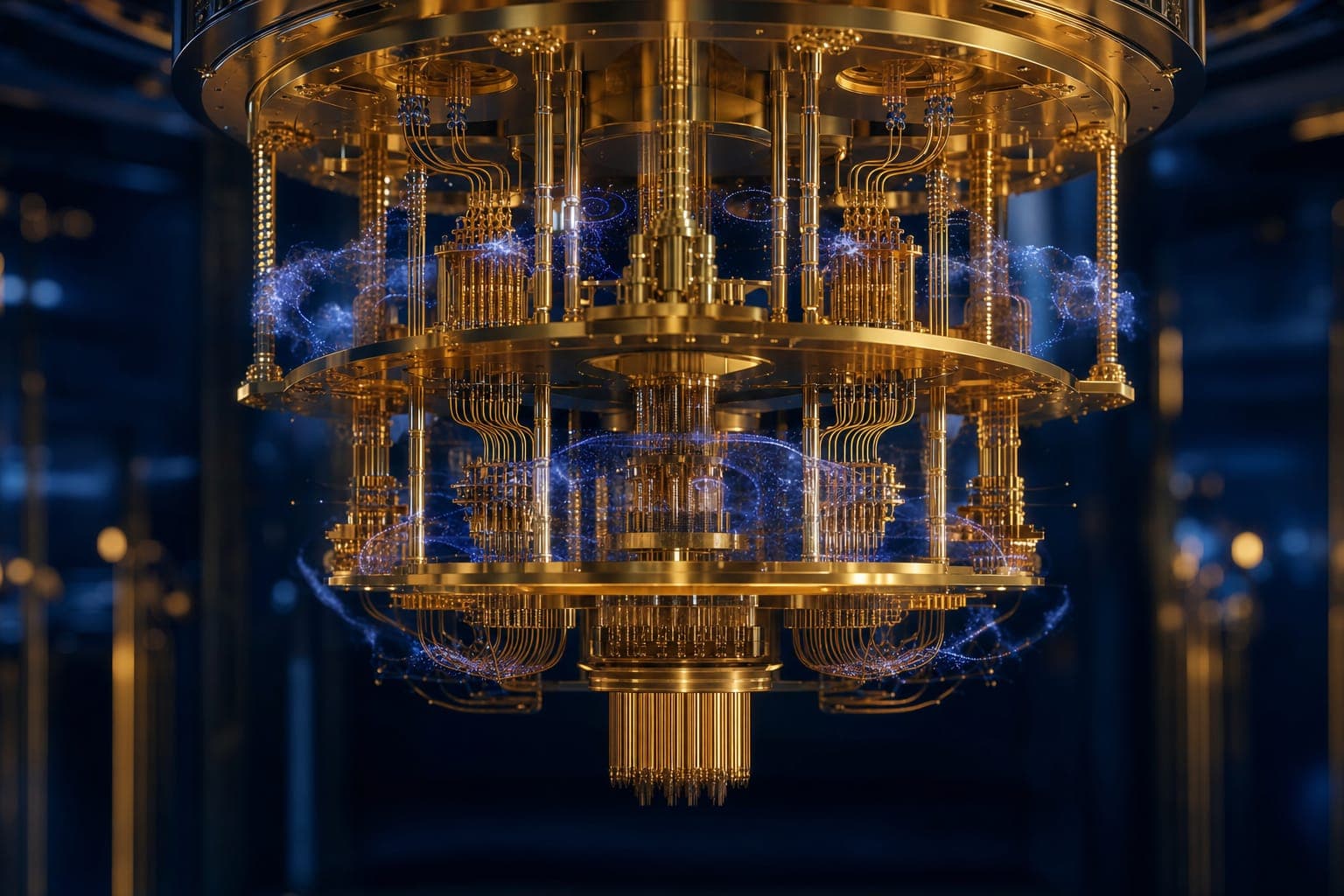
Google's Willow arrived in late 2024 with 105 superconducting qubits and a result the field had chased for decades: below-threshold error correction, meaning that grouping more physical qubits into a logical qubit made errors go down, not up. Willow ran a benchmark computation in under five minutes that Google estimates would take a classical supercomputer around 10 septillion years. Then in late 2025, Google's Quantum Echoes algorithm ran a physics computation the company describes as the first verifiable quantum advantage on hardware — verifiable because another quantum computer can check the answer.
IBM is playing a longer, more methodical game. Its 120-qubit Nighthawk processor, announced in late 2025, anchors a public roadmap that targets demonstrated quantum advantage by the end of this year and a fault-tolerant system called Starling by 2029 — roughly 200 logical qubits built from about 10,000 physical ones, capable of circuits with 100 million gates. IBM also reported hitting a key error-correction decoding milestone a year ahead of its own schedule, which is the kind of unglamorous progress that actually matters.
Microsoft's Majorana 1, unveiled in February 2025, is the wildcard: the first processor built on topological qubits, which are theoretically far more stable than conventional designs. It's worth knowing about and worth healthy skepticism — the underlying physics claims have drawn scrutiny from researchers, and the device remains a research prototype with a handful of qubits. If the approach pans out, it changes the scaling math entirely. That's an "if," not a "when."
Add IonQ's trapped-ion systems — which trade speed for some of the highest-fidelity qubits in the industry and are available through every major cloud — and you have a genuinely competitive race with fundamentally different architectures. Nobody knows which one wins. That uncertainty is normal for this stage of a technology, and it's why the cloud model matters so much.
Real Applications Running in 2026
Here's the part that's changed most: quantum computers are no longer just computing about themselves. Actual workloads, run by actual companies, fall into four buckets.
Drug discovery and chemistry. Simulating molecules is the application quantum computers were born for, because molecules are themselves quantum systems. Pharmaceutical researchers are using quantum processors alongside classical HPC to model molecular interactions and binding behavior, with peer-reviewed work on quantum-assisted drug discovery now appearing in major journals. Today's machines handle small molecules that classical computers can often still match — the value is in building validated pipelines for the larger systems coming within a few years.
Materials science. The same simulation advantage applies to batteries, catalysts, and superconductors. Automakers and energy companies are running quantum chemistry experiments targeting better cathode materials and nitrogen fixation catalysts. Like drug discovery, this is co-processing: quantum handles the gnarly electron-correlation core of a problem while classical systems do the rest.
Finance. Banks were among the earliest paying customers, and the pilots have grown teeth. HSBC and IBM reported in late 2025 that a quantum-assisted approach improved bond-trade fill predictions by a meaningful margin over classical baselines — one of the first published results where quantum hardware added measurable value on production-shaped financial data. Portfolio optimization, derivatives pricing, and risk modeling pilots are running at most major institutions, a trend we anticipated in How Quantum Computing Will Revolutionize Industries.
Optimization and logistics. D-Wave's annealing machines — a different, more specialized flavor of quantum computing — have quietly racked up the most production deployments: grocery logistics, manufacturing scheduling, and workforce routing, where customers report real operational savings. Purists note annealers can't run general quantum algorithms. Customers note they don't care.
The honest caveat across all four: in most cases, a well-tuned classical algorithm can still match or beat today's quantum results. The companies investing now are paying for a head start, not an immediate payoff.
Cloud Quantum: How You Can Try It Today
You do not need a dilution refrigerator. Every major quantum company rents access by the second, and the on-ramp is gentler than most people expect.
- IBM Quantum Platform offers free monthly access to real superconducting processors — over 100 qubits — plus Qiskit, the field's most widely used open-source SDK. You can run your first real quantum circuit in an afternoon.
- Amazon Braket aggregates hardware from IonQ, Rigetti, IQM, and QuEra behind one AWS API, with pay-as-you-go pricing that makes experiments cost dollars, not thousands.
- Microsoft Azure Quantum bundles IonQ and Quantinuum hardware with its resource estimator, which tells you what a given algorithm would require on future fault-tolerant machines — arguably the most useful planning tool in the industry.
- Google provides Cirq and its quantum hardware to research partners, with simulators available to everyone.
For developers, the practical advice is simple: learn Qiskit or Cirq, run the tutorials on simulators, then spend a few dollars on real hardware to feel the difference noise makes. Quantum literacy is becoming a differentiator in the same way GPU literacy was in 2015 — and the people who understood GPUs early did rather well for themselves.
Two expectations worth setting before your first job runs. First, queues are real: free-tier jobs on popular backends can wait minutes to hours, which is fine for learning and annoying for iteration. Second, your results will be noisy — run the same small circuit twice and you'll get slightly different answer distributions, which is the entire error-correction problem made visceral. That hands-on intuition for noise, calibration, and shot counts is precisely what separates people who understand quantum computing from people who have merely read about it.
Quantum Computing's Dark Side: The Encryption Deadline
There's one quantum application you're already using whether you know it or not, and it's defensive.
A sufficiently large quantum computer running Shor's algorithm will break RSA and elliptic-curve cryptography — the math protecting essentially all internet traffic, banking, and digital signatures. No machine today is close. But intelligence agencies and criminals are betting on "harvest now, decrypt later": capturing encrypted data today to decrypt once the hardware exists. Anything that must stay secret for a decade — health records, state secrets, corporate IP — is effectively already at risk, a threat serious enough that the Federal Reserve has published research on it.
The fix is underway. NIST finalized its first post-quantum cryptography standards — ML-KEM, ML-DSA, and SLH-DSA — in August 2024, and migration guidance followed. The US government has set 2035 as the federal migration deadline, with national security systems on a faster clock. Deployment is further along than most people realize: Chrome, Signal, and Apple's iMessage already use post-quantum key exchange, and Cloudflare reported that more than half of human-generated traffic on its network was protected by post-quantum key agreement by late 2025.
For individuals, this mostly happens invisibly in software updates — one more reason to install them promptly, alongside the basics in Stay Safe: Cybersecurity Tips and Tricks — and it's part of why services like the ones we examined in Password Managers in 2026: Are They Still Necessary? are racing to adopt quantum-resistant encryption for their vaults. For anyone running a business, the question to ask your vendors this year is blunt: what's your post-quantum migration plan? If the answer is a blank stare, that tells you something.
The Honest Hype Check
Time for the part most quantum coverage skips. As of mid-2026:
- No quantum computer has solved a commercially valuable problem that classical computers provably cannot. Advantage demonstrations so far involve physics benchmarks and narrow tasks, not spreadsheet-changing business results.
- Logical qubit counts remain small. The field has demonstrated dozens of logical qubits in research settings; useful fault-tolerant applications likely need hundreds to thousands. That's the gap between now and roughly 2029-2033 on the credible roadmaps.
- "Q-Day" is not imminent. Breaking RSA-2048 requires millions of physical qubits by most estimates. The urgency around post-quantum cryptography is about data lifetimes, not an impending cliff.
- Quantum machine learning remains mostly aspirational. Despite the buzzword gravity of "quantum AI," there's no demonstrated advantage for mainstream ML workloads yet.
And yet the trajectory is unmistakable. Error rates are falling on schedule, error correction now demonstrably works, two major vendors have credible public roadmaps to fault tolerance before 2030, and real money — government and private — is flowing at unprecedented scale. The field's own consensus puts broad commercial viability in the early 2030s. For once, the vendors' timelines and the skeptics' timelines are only a few years apart. That convergence is itself news.
What This Means for You
If you're a developer, spend a weekend with Qiskit and the free IBM tier. You won't ship quantum features this year, but the mental model — superposition, entanglement, interference, and above all noise — takes time to build, and demand for people who have it is growing faster than supply.
If you're in leadership at a company with hard optimization, simulation, or risk problems, 2026 is the year to run a scoped pilot through a cloud provider. The cost of finding out quantum doesn't help your problem yet is a few thousand dollars. The cost of being three years behind a competitor who found out it does is considerably more.
If you're anyone with data that must stay confidential past 2035, post-quantum migration is not optional and not premature. The standards exist, the tooling exists, and the attackers are already harvesting.
The key takeaway: quantum computing in 2026 is no longer a question of whether, only of when and for what. The applications you can touch today — chemistry simulation, financial modeling, logistics optimization, and quantum-safe encryption — are early, narrow, and real. Treat the technology like the early internet circa 1994: easy to dismiss, cheap to explore, and very expensive to ignore for too long.