Your Next Diagnosis May Already Involve an Algorithm
Here's a quiet milestone that slipped past most people: by the end of 2025, the FDA had authorized more than 1,450 AI-enabled medical devices — up from just a handful a decade ago. If you've had a mammogram, a CT scan, or even a routine eye exam at a well-equipped clinic recently, there's a reasonable chance artificial intelligence diagnosing disease wasn't a future scenario for you. It already happened, quietly, somewhere in your chart.
And yet the phrase "AI doctor" still oversells what's actually going on. The reality in 2026 is more interesting than the hype: AI has become a genuinely superhuman pattern-spotter in a few narrow domains, a competent assistant in many others, and a confident liar in just enough cases that no serious health system lets it work alone. Let's walk through what these systems actually do, what the evidence says, and what it means the next time you're the patient.
How AI Is Diagnosing Disease Today: Where It Already Works
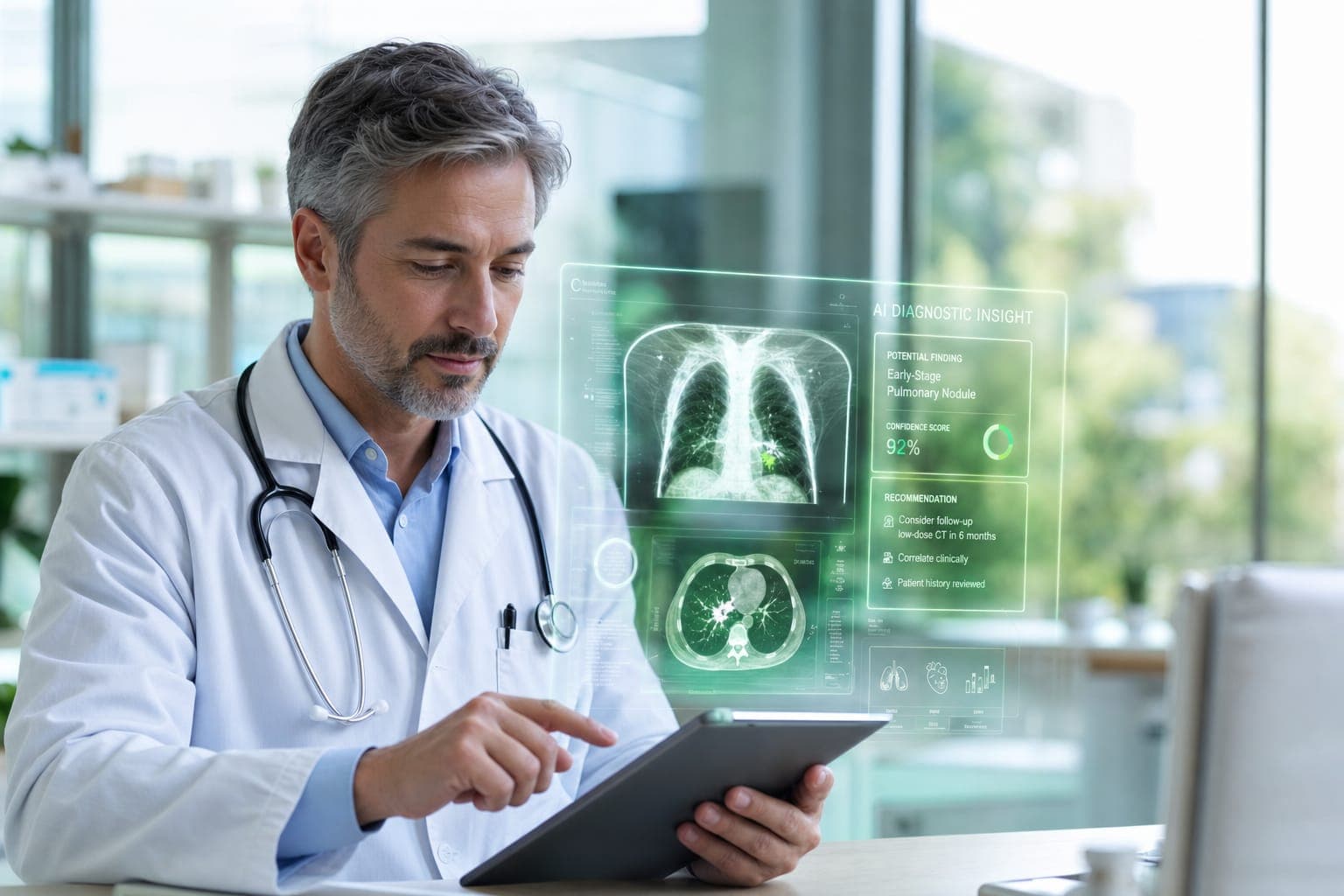
The unglamorous truth is that medical AI's biggest wins are in imaging — turning pixels into probabilities. According to FDA tracking data, radiology accounts for roughly 76 percent of all AI device authorizations — over 1,100 cleared tools that flag suspected strokes on brain CTs, spot lung nodules, prioritize urgent cases in the reading queue, and measure things humans find tedious, like coronary calcium or bone density.
Three areas stand out as genuinely mature:
- Radiology. AI triage tools now routinely re-order radiologists' worklists so a brain bleed gets read in minutes instead of hours. Large vendors like GE HealthCare have amassed over a hundred cleared algorithms each, and most new imaging equipment ships with AI built in.
- Ophthalmology. The system now called LumineticsCore (formerly IDx-DR) made history in 2018 as the first FDA-authorized AI that diagnoses without a clinician interpreting the result. A primary care medical assistant photographs your retina; the algorithm decides on the spot whether you need a specialist for diabetic retinopathy. No eye doctor required for the screen itself.
- Dermatology. The FDA-authorized DermaSensor device lets primary care physicians evaluate suspicious skin lesions for cancer with an AI-backed handheld scanner — extending a scarce specialty into ordinary clinics, where most skin checks actually happen.
Notice the pattern: each of these wins is a narrow, well-defined question with abundant training data. "Is there diabetic retinopathy in this image?" is exactly the kind of problem deep learning eats for breakfast. "Why has this 54-year-old felt exhausted for six months?" is not — at least, not yet.
Cardiology is following close behind, with cleared algorithms reading ECGs for arrhythmias and estimating heart function from ultrasound. Pathology — analyzing biopsy slides — is earlier in the curve but moving fast as labs digitize. The common thread is that wherever medicine produces a standardized image and a clear yes-or-no question, an algorithm is being trained to answer it.
The New Wave: Large Medical Models and Conversational AI
The past two years brought something different: large language models tuned for medicine, which can take a history, reason through symptoms, and propose a differential diagnosis in plain language.
The most striking result so far is Google's AMIE (Articulate Medical Intelligence Explorer). In a study published in Nature in 2025, AMIE conducted text-based diagnostic conversations with patient-actors across 159 case scenarios and was compared head-to-head with 20 primary care physicians. Specialist judges rated the AI more accurate, and better on 30 of 32 measured axes — including, uncomfortably for humans, empathy and communication quality.
That's a landmark — and it comes with heavy caveats. It was a controlled study with actors typing in a chat window, not real patients with messy histories, incomplete records, and bodies that need examining. The broader evidence is far more sobering. A 2025 meta-analysis of 83 studies found generative AI models averaged just 52.1 percent diagnostic accuracy across tasks — statistically on par with non-expert physicians, but significantly worse than specialists in their own fields.
Both findings can be true at once. The best systems, on their best benchmarks, rival good doctors. The average system, on the average task, is a middling medical student with infinite confidence. The gap between those two realities is where patients can get hurt.
Meanwhile, the most widely deployed medical AI of all doesn't diagnose anything. Ambient AI scribes — software that listens to your visit and drafts the clinical note — became a billion-dollar market in 2025, with health systems reporting meaningful drops in documentation time and burnout. One multi-site study found physician burnout fell from 51.9 percent to 38.8 percent within 30 days of adopting a scribe. That matters for diagnosis too: a doctor looking at you instead of a keyboard is a doctor more likely to catch what's wrong.
Can AI Diagnose Disease Better Than Doctors? The Honest Answer
It depends entirely on the task — and the evidence supports three different answers.
In narrow image analysis: often yes. For specific, high-volume tasks like detecting diabetic retinopathy or flagging certain cancers on screening images, validated AI systems match or beat the average specialist, never fatigue, and perform identically at 3 a.m. as at 9 a.m. That last part is no small thing in medicine.
In open-ended diagnosis: not reliably. Real diagnosis means weighing a lifetime of context, examining a body, noticing what the patient didn't say, and updating as labs come back. Today's models still hallucinate plausible-sounding nonsense, and they struggle with rare presentations and incomplete information — exactly the cases where diagnosis is hardest.
Together: better than either alone — usually. Multiple studies show physicians using AI assistance catch findings they'd otherwise miss. But the pairing has a failure mode researchers call automation bias: clinicians accepting a wrong AI suggestion they would have gotten right on their own. Recent work has found that even physicians trained in AI's limitations remain susceptible to this. The "human in the loop" only protects you if the human stays genuinely skeptical.
There's also the bias problem, and it's not hypothetical. Models trained mostly on lighter skin tones underperform on darker skin — a serious concern in dermatology AI. Datasets skewed toward academic medical centers can miss how disease presents in underserved populations. An algorithm can inherit decades of inequity in its training data and then apply it at scale, with a veneer of objectivity. Regulators now ask for demographic performance breakdowns, but the field is still catching up to its own blind spots.
And one more honest limitation: most cleared AI devices were validated on retrospective data, not tested in randomized trials the way a new drug would be. Performance in a curated study population doesn't always survive contact with a community hospital's older scanners and sicker patients. The handful of tools that have gone through prospective, real-world trials — like the autonomous retinopathy screeners — earned their autonomy. Many others are still, in a meaningful sense, being field-tested on the public.
Beyond Diagnosis: AI Across the Whole Care Journey
Diagnosis is one step in a longer pipeline, and AI is threading through all of it. The same computer vision advances that read X-rays now guide instruments and robotic platforms in the operating room — a frontier we've covered in depth in The Role of Artificial Intelligence in Surgical Procedures.
Imaging itself keeps getting smarter, with AI reconstructing sharper scans from lower radiation doses — part of a longer arc we traced in Advancements in Surgical Imaging: From X-Rays to 3D Imaging. And after diagnosis, AI-monitored wearables and remote care are starting to close the loop, flagging deterioration before a patient knows anything is wrong — the natural extension of the virtual-care model we examined in Telemedicine in Surgery: Remote Surgical Consultations and Procedures.
There's an access story here too, and it may matter more globally than any accuracy benchmark. Most of the world's population lives where specialists are scarce: many low-income countries have a small fraction of the radiologists per capita that the US does. An algorithm that brings competent screening to a clinic with no specialist within a hundred miles isn't competing with a doctor — it's competing with nothing. That's where autonomous diagnosis will likely prove its worth first and most decisively.
The realistic near-term picture isn't an AI doctor replacing yours. It's AI compressing the boring 80 percent of medicine — screening, measuring, documenting, triaging — so scarce human expertise concentrates on the hard 20 percent.
What Patients Should Actually Expect in 2026
If you're seeing a doctor this year, here's how AI is most likely to touch your care, ranked from most to least probable:
- Your visit note may be AI-drafted. Your clinician should mention the scribe and get your okay. You can decline.
- Your scans get a second reader. If you have imaging done, an algorithm probably pre-screened it. You may never be told — currently there's no universal disclosure requirement, which deserves more debate than it's getting.
- Routine screening may be AI-first. Diabetic eye exams in primary care, skin lesion checks, some mammography programs. A positive still routes you to a human specialist.
- Your doctor may consult an AI reference. Clinical-grade tools are increasingly common for differential diagnoses and literature checks — a smarter version of what they once did with textbooks.
Reasonable questions to ask: Is an AI tool involved in this result? Is it FDA-cleared for this use? Did a physician review it? Good clinicians won't bristle at any of these.
And a word of caution in the other direction: consumer chatbots are not diagnostic devices. They can help you prepare questions or understand a diagnosis you've already received. Using one as your doctor means trusting a system that, across studies, gets roughly half of diagnostic tasks wrong — while sounding equally confident either way.
The Bottom Line: Augmented, Not Artificial, Doctors
Step back and the trajectory is unmistakable. In eight years, autonomous AI diagnosis went from one cleared device to a routine part of primary care screening. Medical language models went from autocomplete to outperforming physicians in controlled diagnostic conversations. The FDA's authorization count is climbing by hundreds per year. Whatever medicine looks like in 2036, AI will be load-bearing infrastructure.
But the evidence from 2026 points to a clear division of labor, not a replacement. AI is becoming medicine's tireless front line — screening everyone, missing little, escalating what matters — while humans handle ambiguity, context, judgment, and the conversation where a diagnosis becomes a plan a real person can live with. The systems that work best today are explicitly designed around that partnership, and the failures happen when either side trusts the other too much.
The key takeaway: the question to ask in 2026 isn't whether an AI can out-diagnose your doctor — in narrow tasks it already can, and in general practice it reliably can't. The question is whether your doctor is working with validated AI and staying appropriately skeptical of it. The combination, deployed carefully, is the best diagnostic medicine humanity has ever had. We're still learning, sometimes painfully, what "deployed carefully" means.